Last updated: April 10, 2026
Quick Answer
Non-flammable electric motor cleaning spray functions by using ultra-high purity, fast-evaporating solvents that penetrate motor components to dissolve grease, oil, and contaminants, then evaporate rapidly without leaving residue. These sprays maintain dielectric properties that prevent electrical conductivity, allowing safe use on energized equipment without fire risk or short circuits. The combination of high solvency, rapid evaporation, and non-conductive formulation makes them effective for cleaning motors while maintaining operational safety.
Key Takeaways
- Non-flammable electric motor cleaning spray uses specialized solvents that dissolve grease and oil while evaporating quickly without residue
- Dielectric strength ratings (typically 29,000-37,500 volts) prevent electrical arcing and allow safe use on energized motors
- Fast evaporation rates minimize downtime by allowing motors to return to service within minutes after cleaning
- No flash point formulations eliminate fire hazards in industrial environments with sparks or heat sources
- Moisture displacement properties protect components from corrosion and oxidation after cleaning
- Plastic-safe formulations avoid damaging insulation, housings, and other non-metallic motor parts
- Application involves controlled spraying from top to bottom while motor is positioned vertically for optimal contaminant flushing
- Shelf life typically ranges from 2-5 years depending on storage conditions and container integrity
- VOC regulations affect availability in certain regions but don’t change core cleaning function
- Works on armatures, windings, brushes, stators, and other motor components without disassembly
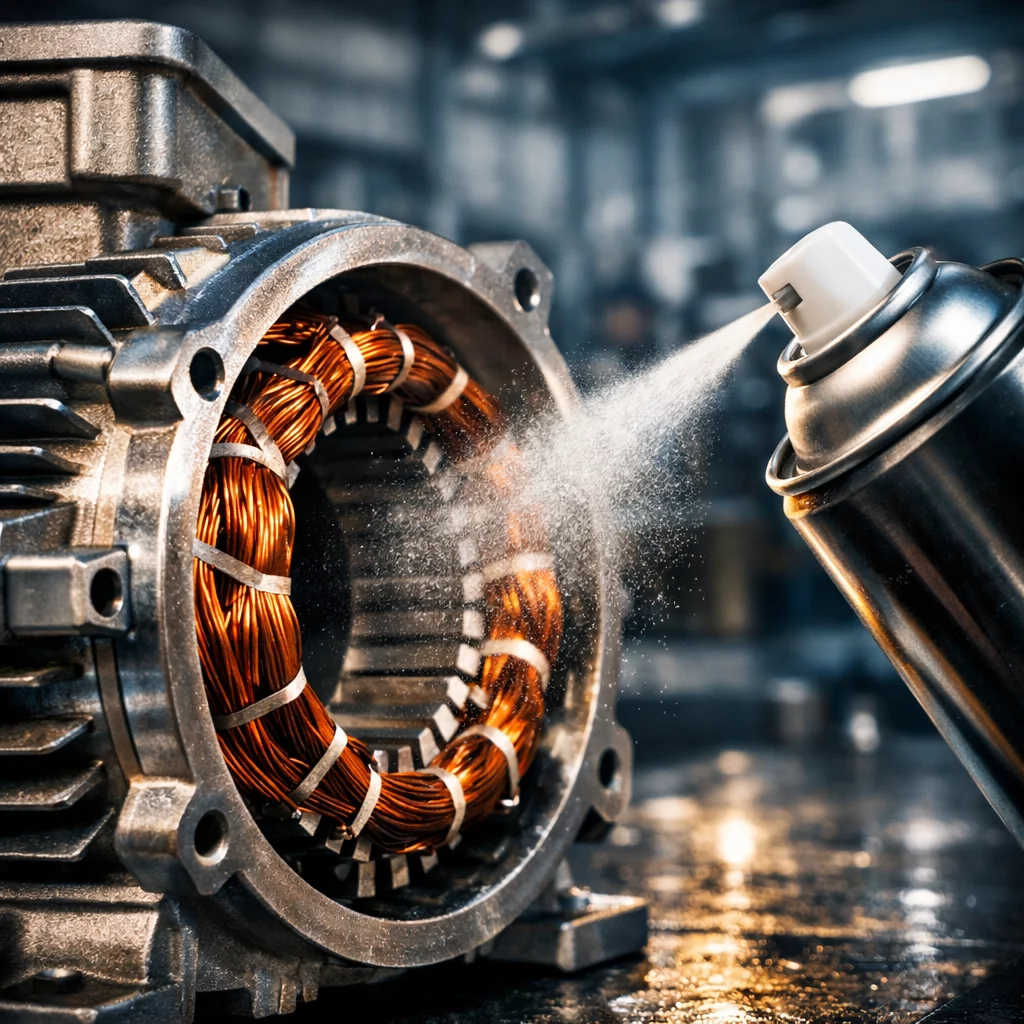
What Chemical Mechanism Powers Non-Flammable Electric Motor Cleaning Spray?
Non-flammable electric motor cleaning spray relies on high-solvency, non-chlorinated organic solvents that break molecular bonds in oils and greases without creating combustion risks. These formulations typically exclude chlorofluorocarbons (CFCs), trichloroethylene, and other hazardous chlorinated compounds while maintaining aggressive cleaning power.
The chemical action works through several simultaneous processes:
Solvent Penetration
- Molecules infiltrate between contaminant layers and metal surfaces
- Low surface tension allows deep penetration into tight spaces like winding gaps
- Capillary action draws solvent into areas inaccessible to mechanical cleaning
Contaminant Dissolution
- Solvent molecules surround and break apart hydrocarbon chains in oils and greases
- Polar and non-polar solvent components attack different contaminant types
- Emulsification suspends dissolved particles for easy removal
Rapid Phase Change
- High vapor pressure causes immediate evaporation at room temperature
- Heat from motor operation accelerates evaporation process
- Volatile compounds transition from liquid to gas within seconds to minutes
Dielectric Maintenance
- Non-conductive molecular structure prevents electron flow
- Maintains insulation integrity during and after cleaning
- No ionic residues that could create conductive paths
The absence of flammable propellants and solvents means these products contain no flash point—the temperature at which vapors can ignite. This makes them fundamentally safer than petroleum-based cleaners in environments with electrical sparks, hot surfaces, or open flames.
Common mistake: Assuming all “non-flammable” cleaners are identical. Formulations vary significantly in solvency strength, evaporation rate, and material compatibility. Choose products specifically rated for electric motors rather than general-purpose degreasers.
How Does Non-Flammable Electric Motor Cleaning Spray Achieve Dielectric Protection?
The dielectric function of non-flammable electric motor cleaning spray prevents electrical current from flowing through the cleaning solution, protecting both equipment and operators. Products typically achieve dielectric strength ratings between 29,000 and 37,500 volts, meaning they can withstand these voltage levels without breaking down and conducting electricity.
Dielectric Properties Explained:
| Property | Function | Typical Value |
|---|---|---|
| Dielectric Strength | Maximum voltage before breakdown | 29,000-37,500 volts |
| Resistivity | Opposition to current flow | >10^12 ohm-cm |
| Dissipation Factor | Energy loss in electric field | <0.01 |
| Breakdown Voltage | Point of insulation failure | Exceeds motor operating voltage |
The molecular structure of these solvents lacks free electrons and ionic components that would enable electrical conductivity. This allows technicians to spray directly onto energized motors without creating short circuits or shock hazards.
Practical application: When cleaning a 480-volt three-phase motor, a spray with 37,500-volt dielectric strength provides a safety margin of nearly 80 times the operating voltage. This accounts for voltage spikes, transients, and localized field concentrations.
Edge case: Dielectric properties degrade if the spray becomes contaminated with conductive materials like metal particles or ionic salts. Always use clean spray equipment and avoid cross-contamination with other chemicals.
The dielectric function also prevents arcing between closely spaced conductors during cleaning. In motor windings where copper wires sit millimeters apart at different voltage potentials, the non-conductive solvent acts as a temporary insulator while flushing away conductive contaminants like carbon dust or metallic debris.
What Makes the Evaporation Process Critical to Function?
Fast evaporation is essential to non-flammable electric motor cleaning spray function because it determines downtime, residue formation, and moisture-related damage. These products evaporate 10-50 times faster than water, with complete drying occurring in 30 seconds to 5 minutes depending on temperature and airflow.
Evaporation Rate Factors:
- Vapor pressure – Higher pressure means faster evaporation at given temperature
- Molecular weight – Lighter molecules escape liquid phase more readily
- Surface area – Thin films on motor parts evaporate faster than pooled liquid
- Ambient temperature – Each 10°C increase roughly doubles evaporation rate
- Airflow – Ventilation removes saturated vapor and accelerates drying
- Motor heat – Operating motors provide thermal energy for faster evaporation
The rapid phase change serves multiple functions beyond just drying. As solvent evaporates, it carries away dissolved contaminants and displaced moisture, effectively flushing them from motor surfaces. This self-cleaning action eliminates the need for wiping or rinsing, which could introduce lint or leave streaks.
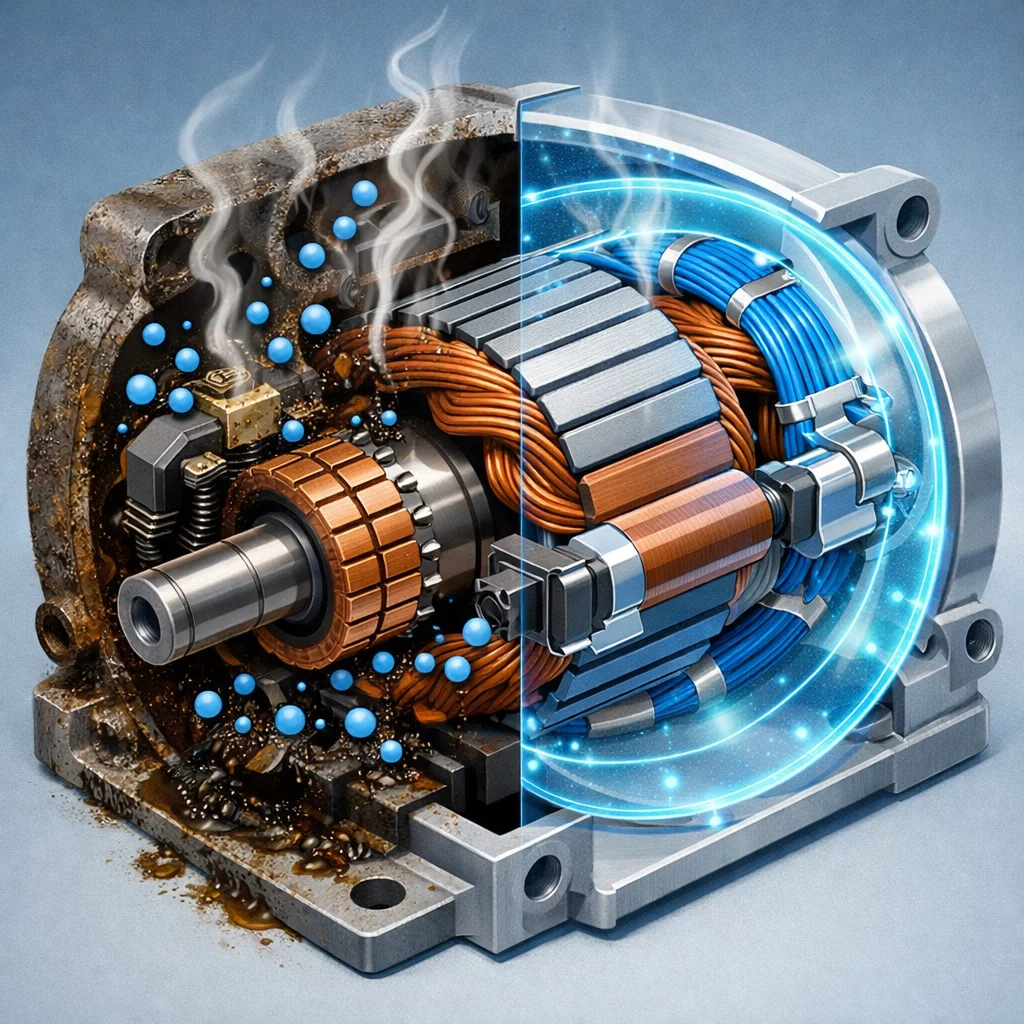
Moisture displacement occurs because these solvents have lower surface tension than water. When sprayed onto damp motor components, the solvent undercuts water droplets and lifts them away from metal surfaces. As the solvent evaporates, it carries the water vapor with it, leaving dry surfaces less prone to corrosion.
Choose fast evaporation if: You need to minimize production downtime and return motors to service quickly. Most industrial applications prioritize speed.
Choose moderate evaporation if: You’re cleaning heavily contaminated motors where longer dwell time improves dissolving action. Some maintenance shops prefer products that stay wet for 2-3 minutes.
The evaporation process also provides a safety function by removing flammable contaminants. Oil and grease residues that could ignite from motor heat or sparks are dissolved and carried away as the solvent evaporates, reducing fire risk.
How Do You Apply Non-Flammable Electric Motor Cleaning Spray for Optimal Function?
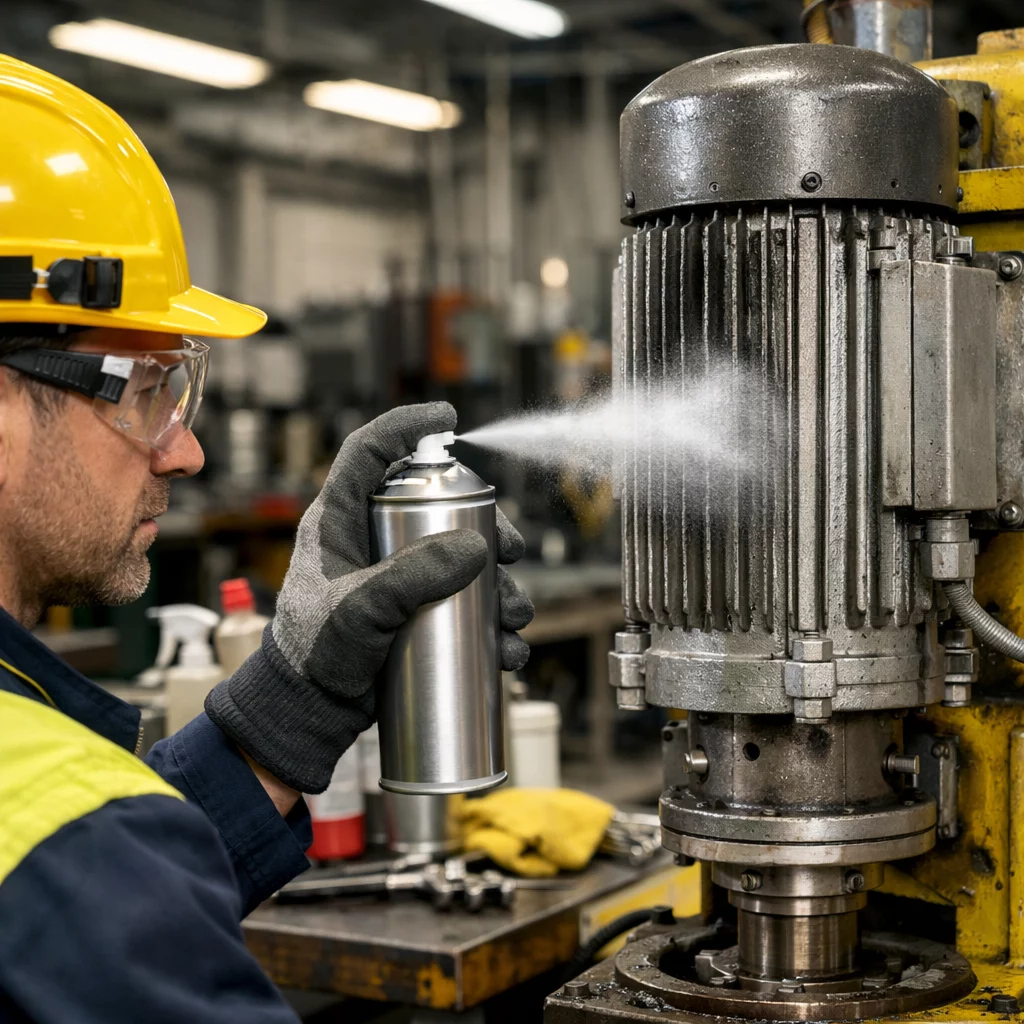
Proper application technique directly affects cleaning effectiveness and safety. The standard method involves positioning the motor vertically and applying spray from top to bottom in a controlled pattern that flushes contaminants downward and outward.
Step-by-Step Application Process:
Prepare the work area
- Ensure adequate ventilation (minimum 4 air changes per hour)
- Position motor vertically if possible for gravity-assisted drainage
- Place drip pan or absorbent material below motor to catch runoff
- Verify spray nozzle is clean and unobstructed
Initial assessment
- Identify heavily contaminated areas requiring extra attention
- Check for loose debris that should be removed mechanically first
- Note any damaged insulation or components needing repair
- Determine if motor can remain energized or should be de-energized
Apply cleaning spray
- Hold can 6-12 inches from surface for optimal coverage
- Start at highest point (top of motor housing or shaft)
- Use short, controlled bursts rather than continuous spray
- Work systematically downward to flush contaminants
- Apply heavier coating to areas with visible buildup
Brush if needed
- Use non-metallic brush (nylon or natural bristle) for stubborn deposits
- Brush while surface is still wet with solvent
- Follow motor winding direction to avoid damaging wire insulation
- Reapply spray as needed to maintain wet surface
Allow evaporation
- Wait 1-5 minutes depending on product and conditions
- Increase ventilation to speed drying if time-critical
- Verify complete dryness before re-energizing de-energized motors
- Inspect for any remaining contamination requiring second application
Post-cleaning inspection
- Check for residue or streaking (indicates incomplete evaporation)
- Verify all contaminants have been removed
- Look for any damage revealed by cleaning
- Test motor operation if it was de-energized
Application volume varies with motor size and contamination level. A typical 5-horsepower motor requires 4-8 ounces of spray for thorough cleaning, while a 50-horsepower motor might need 16-32 ounces.
Common mistake: Over-application that creates pooling in motor cavities. Excess solvent takes longer to evaporate and may drip onto surrounding equipment. Use multiple light coats rather than one heavy application.
For energized motors: Maintain extra caution even though the spray is non-conductive. Avoid spraying directly into terminal boxes or onto exposed electrical connections. Focus on motor housing, cooling fins, and external surfaces.
What Contaminants Can Non-Flammable Electric Motor Cleaning Spray Remove?
Non-flammable electric motor cleaning spray effectively dissolves and removes petroleum-based contaminants, carbon deposits, and certain particulates through chemical and mechanical action. Understanding what these products can and cannot remove helps set realistic expectations and choose appropriate cleaning methods.
Effectively Removed Contaminants:
✅ Petroleum oils and lubricants – Motor oil, hydraulic fluid, gear oil, cutting oil ✅ Greases – Lithium, calcium, and synthetic greases from bearings and gears ✅ Carbon deposits – Brush carbon, combustion residue, electrical arcing byproducts ✅ Tar and asphalt – Road tar, roofing tar, bituminous coatings ✅ Waxes – Paraffin wax, petroleum wax, some synthetic waxes ✅ Sludge – Oxidized oil mixtures, degraded lubricants ✅ Dirt and dust – When suspended in oil or grease films ✅ Flux residues – Some types from electrical repairs ✅ Silicone contamination – Light silicone oils and greases
Poorly Removed or Resistant Contaminants:
❌ Water-based contaminants – Coolant, water-soluble cutting fluids (displaced but not dissolved) ❌ Dried paint – Cured coatings require mechanical removal ❌ Rust and corrosion – Oxidized metal requires abrasive or chemical rust removal ❌ Mineral scale – Calcium, lime, and hard water deposits ❌ Polymerized oils – Heavily oxidized, baked-on oil films ❌ Adhesives – Most cured adhesives and epoxies ❌ Heavy particulates – Metal chips, grinding dust (mechanically removed but not dissolved)
The solvency power depends on the “like dissolves like” principle—non-polar solvents in these sprays effectively dissolve non-polar contaminants like oils and greases. They work less effectively on polar contaminants like salts or water-based materials.
For mixed contamination: Apply the spray first to remove oils and greases, then use appropriate specialized cleaners for remaining contaminants. For example, clean oil-soaked dust with motor spray, then address rust spots with rust remover.
Edge case: Some synthetic lubricants (particularly perfluorinated types) resist standard motor cleaners. If motors use exotic lubricants, verify compatibility and effectiveness before committing to large-scale cleaning.
The mechanical flushing action of the spray also removes loose particulates by carrying them away in the liquid flow. This works best when motors are positioned to allow gravity drainage and when adequate spray volume is used to create flushing action.
How Does Non-Flammable Electric Motor Cleaning Spray Protect Motor Components?
Beyond cleaning, non-flammable electric motor cleaning spray provides protective functions that extend motor life and prevent damage during the cleaning process. These protective mechanisms operate through material compatibility, moisture displacement, and residue-free formulation.
Material Compatibility Protection:
Modern motor cleaners are formulated to be safe for the diverse materials found in electric motors:
- Insulation materials – Varnish, enamel, polyester, epoxy coatings remain intact
- Plastics – Nylon, ABS, polycarbonate housings and components not degraded
- Elastomers – Rubber gaskets, O-rings, and seals not swollen or dissolved
- Metals – Copper, aluminum, steel, and alloys not corroded or tarnished
- Composite materials – Fiberglass and carbon fiber components remain bonded
This compatibility prevents the cleaning process from causing more damage than the contamination itself. Older chlorinated solvents often attacked plastics and rubber, requiring extensive disassembly before cleaning. Modern non-flammable formulations allow spray-in-place cleaning without component removal.
Moisture Displacement:
Water is one of the most damaging contaminants for electric motors, causing:
- Insulation breakdown and reduced dielectric strength
- Corrosion of copper windings and steel laminations
- Bearing damage from water-contaminated lubricants
- Electrical tracking and short circuits
Non-flammable motor cleaners displace moisture through lower surface tension and higher spreading coefficient. When sprayed onto damp surfaces, the solvent undercuts water droplets and lifts them away. As the solvent evaporates, it carries water vapor with it, leaving surfaces drier than before application.
Residue-Free Formulation:
The absence of residue after evaporation provides multiple protective benefits:
- No conductive paths – Prevents tracking between conductors at different potentials
- No insulation degradation – Residues can chemically attack insulation over time
- No dust attraction – Sticky residues attract and hold contaminating particles
- No bearing contamination – Residues won’t wash into bearings and cause wear
- No thermal issues – Residue films can reduce heat transfer and cause hot spots
Choose residue-free products if: You’re cleaning precision motors, servo motors, or any application where even trace contamination affects performance. Most industrial applications require residue-free formulations.
Oxidation prevention occurs because the cleaning process removes corrosive contaminants like acids, salts, and moisture that accelerate metal oxidation. Clean, dry motor surfaces resist corrosion better than contaminated surfaces.
A maintenance supervisor at a food processing plant shared that switching to non-flammable motor cleaner reduced motor failures by 40% over two years. The key was removing hygroscopic contaminants that absorbed moisture from the humid environment, preventing the moisture-related insulation failures that had plagued their operation.
What Safety Advantages Does Non-Flammable Electric Motor Cleaning Spray Offer?
The non-flammable characteristic fundamentally changes the risk profile of motor cleaning operations, eliminating fire and explosion hazards while maintaining effective cleaning performance. This safety advantage becomes critical in industrial environments with multiple ignition sources.
Fire Safety Benefits:
No flash point means these products cannot be ignited by:
- Electrical sparks from motor brushes or switches
- Hot motor surfaces (motors routinely reach 80-120°C)
- Static electricity discharge during spray application
- Nearby welding, cutting, or grinding operations
- Pilot lights or open flames in facility
Traditional petroleum-based cleaners have flash points as low as -20°C, meaning their vapors can ignite at room temperature. Non-flammable formulations eliminate this risk entirely, allowing cleaning during production rather than requiring facility shutdown.
Electrical Safety:
The dielectric properties provide protection against:
- Shock hazard – Non-conductive formula prevents current flow through operator
- Arc flash – No conductive path between energized components
- Ground faults – Spray won’t create unintended ground connections
- Short circuits – Maintains insulation between conductors at different potentials
This allows cleaning of energized equipment when de-energizing would cause production loss or safety issues (emergency systems, critical infrastructure).
Operator Health and Safety:
Modern non-flammable motor cleaners reduce exposure risks:
- Lower toxicity – Elimination of chlorinated solvents reduces carcinogenic exposure
- Reduced vapor hazard – Fast evaporation minimizes inhalation exposure time
- No skin sensitization – Most formulations avoid strong sensitizers
- Reduced environmental impact – No ozone-depleting substances or persistent pollutants
Safety equipment requirements remain important despite improved safety profile:
- Safety glasses or face shield (splash protection)
- Chemical-resistant gloves (nitrile or neoprene)
- Adequate ventilation (mechanical or natural)
- Respiratory protection if ventilation is inadequate
Regulatory compliance is simplified because non-flammable cleaners:
- Don’t require flammable storage cabinets
- Reduce fire insurance premiums in some cases
- Simplify hazard communication and safety data sheet management
- May allow use in areas where flammable materials are prohibited
Common mistake: Assuming “non-flammable” means “completely safe.” These products still contain solvents that require proper handling, ventilation, and disposal. Follow all safety data sheet recommendations.
Edge case: Some non-flammable formulations use compressed gases (CO2, nitrogen) as propellants. While the liquid isn’t flammable, high-pressure release can create static electricity. Ground containers when transferring bulk quantities.
How Long Does Non-Flammable Electric Motor Cleaning Spray Remain Effective?
Shelf life and storage conditions significantly affect the function of non-flammable electric motor cleaning spray. Proper storage maintains cleaning effectiveness, dielectric properties, and safety characteristics throughout the product’s usable life.
Typical Shelf Life:
- Unopened containers: 5 years from manufacture date when stored properly
- Opened aerosol cans: 2 years if nozzle is cleaned after each use
- Bulk containers: 3 years if kept sealed between uses
- Extreme conditions: 1-2 years if exposed to temperature cycling or contamination
Storage Conditions That Preserve Function:
✓ Temperature: Store at 15-30°C (59-86°F) for optimal stability ✓ Humidity: Keep in dry environment to prevent moisture contamination ✓ Light exposure: Store away from direct sunlight to prevent degradation ✓ Container integrity: Ensure caps and seals are tight to prevent evaporation ✓ Orientation: Store aerosol cans upright to maintain propellant function ✓ Separation: Keep away from incompatible chemicals (strong acids, oxidizers)
Degradation Signs:
Watch for these indicators that product function has declined:
- Pressure loss – Aerosol cans spray weakly or not at all
- Separation – Visible layers in liquid (shake well first to verify)
- Discoloration – Yellowing or darkening indicates oxidation
- Odor change – Rancid or unusual smell suggests contamination
- Residue formation – Product leaves film after evaporation
- Reduced cleaning power – Contaminants not dissolving as effectively
Factors That Reduce Shelf Life:
❌ Temperature extremes – Freezing or heat above 50°C accelerates degradation ❌ Contamination – Dirt, water, or other chemicals entering container ❌ Pressure loss – Leaking aerosol cans lose propellant and cleaning agent ❌ UV exposure – Sunlight breaks down some solvent molecules ❌ Moisture absorption – Hygroscopic contamination reduces dielectric strength
Testing aged product: Before using old stock on critical motors, test on scrap components:
- Spray small amount on contaminated test piece
- Verify normal evaporation rate (compare to new product if available)
- Check for residue after complete drying
- Confirm cleaning effectiveness on typical contaminants
Inventory management tip: Use first-in-first-out (FIFO) rotation to ensure oldest stock is used first. Mark containers with receipt date if manufacture date isn’t visible.
A manufacturing facility discovered that motor cleaner stored in a hot warehouse (regularly exceeding 40°C) lost effectiveness after just 18 months, while identical product in climate-controlled storage remained fully functional after 4 years. The lesson: storage conditions matter as much as age.
For bulk operations: Consider buying smaller quantities more frequently rather than large volumes that may degrade before use. Calculate annual usage and purchase 12-18 months’ supply maximum.
What Are the Limitations of Non-Flammable Electric Motor Cleaning Spray?
Understanding what non-flammable electric motor cleaning spray cannot do prevents misapplication and helps identify situations requiring alternative or supplementary cleaning methods. These limitations stem from chemical properties, application constraints, and regulatory factors.
Chemical Limitations:
Solvency gaps – These products excel at petroleum-based contaminants but struggle with:
- Polymerized oils baked onto hot surfaces (require mechanical removal)
- Water-soluble contaminants like coolant or salt deposits
- Cured adhesives, paints, or coatings
- Heavy rust or corrosion (need dedicated rust removers)
Penetration limits – Spray application cannot reach:
- Sealed bearing interiors (bearings must be opened or replaced)
- Internal rotor passages in totally enclosed motors
- Tight crevices where surface tension prevents liquid entry
- Areas blocked by motor design or mounting configuration
Application Constraints:
Ventilation requirements – Despite being non-flammable, these products release solvent vapors requiring:
- Minimum 4 air changes per hour in enclosed spaces
- Respiratory protection if ventilation is inadequate
- Vapor monitoring in confined spaces
- Time delays before entering poorly ventilated areas
Temperature sensitivity – Function is affected by extreme conditions:
- Below 10°C: Slower evaporation, reduced cleaning action
- Above 40°C: Excessive evaporation before contaminants dissolve
- Frozen product: May separate or lose effectiveness permanently
Volume limitations – Aerosol delivery restricts:
- Total cleaning capacity per can (typically 12-20 oz)
- Continuous spray duration (propellant depletes)
- Coverage area for large motors (may require multiple cans)
- Cost-effectiveness for very large or heavily contaminated equipment
Regulatory and Practical Constraints:
VOC restrictions affect availability and formulation:
- Products may not be sold in California, New Jersey, or other regulated areas
- Reformulated “compliant” versions may have different performance
- Bulk alternatives may be required in restricted regions
Cost considerations make spray cleaners impractical for:
- Routine cleaning of very large motors (over 100 HP)
- Facilities with dozens of motors requiring frequent cleaning
- Applications where bulk solvent tanks and parts washers are more economical
Disposal requirements add complexity:
- Used solvent with dissolved contaminants may be hazardous waste
- Aerosol cans require special disposal procedures
- Runoff must be contained and properly disposed
- Environmental regulations vary by jurisdiction
When to Use Alternatives:
Choose ultrasonic cleaning if: You need to clean small components thoroughly, including internal passages and complex geometries.
Choose bulk solvent tanks if: You’re cleaning multiple motors regularly and need cost-effective high-volume cleaning.
Choose mechanical methods if: Contaminants are polymerized, cured, or otherwise resistant to solvent action.
Choose water-based cleaners if: Contaminants are water-soluble or you need to avoid VOC emissions entirely.
Edge case: Some motor designs have internal baffles or passages that trap solvent, preventing complete evaporation. This can cause bearing contamination or insulation damage. Always verify motor design allows complete drainage before spray cleaning.
How Do Different Non-Flammable Electric Motor Cleaning Spray Products Compare?
While all non-flammable motor cleaners share core functional characteristics, specific formulations vary in performance, application, and suitability for different industrial environments. Understanding these differences helps select the optimal product for specific needs.
Key Performance Variables:
| Feature | Range Across Products | Impact on Function |
|---|---|---|
| Dielectric Strength | 29,000-37,500 volts | Higher values provide greater safety margin for high-voltage motors |
| Evaporation Rate | 30 seconds – 5 minutes | Faster rates reduce downtime; slower rates improve heavy contamination removal |
| Solvency Power | Moderate to aggressive | Stronger solvents remove stubborn contaminants but may affect some plastics |
| Plastic Compatibility | Limited to universal | Universal compatibility allows use without material testing |
| VOC Content | 0-850 g/L | Lower VOC products comply with more regulations but may clean less effectively |
| Propellant Type | CO2, nitrogen, hydrocarbon | Affects spray pattern, pressure, and environmental impact |
| Container Size | 10 oz – 5 gallon | Larger sizes reduce per-ounce cost but require different application equipment |
Product Category Comparison:
Premium Fast-Evaporation Products
- Evaporate in 30-60 seconds
- Highest dielectric strength (35,000+ volts)
- Universal plastic compatibility
- Higher cost per ounce
- Best for: Minimizing downtime, precision motors, high-voltage applications
Standard Industrial Products
- Evaporate in 2-3 minutes
- Moderate dielectric strength (29,000-32,000 volts)
- Compatible with most motor materials
- Mid-range pricing
- Best for: General maintenance, routine cleaning, most industrial motors
Heavy-Duty Formulations
- Evaporate in 3-5 minutes
- Aggressive solvency for stubborn contamination
- May require material compatibility testing
- Similar pricing to standard products
- Best for: Heavily contaminated motors, infrequent deep cleaning
VOC-Compliant Versions
- Variable evaporation rates
- Reformulated to meet regional regulations
- May have reduced solvency compared to standard versions
- Similar or higher pricing
- Best for: California, New Jersey, and other regulated areas
Application Method Variations:
Aerosol cans (most common)
- Convenient for spot cleaning and small motors
- Built-in propellant provides spray pressure
- Limited total volume (12-20 oz typical)
- Higher per-ounce cost
- No additional equipment needed
Pump sprayers
- Bulk liquid in refillable spray bottles
- Manual pumping provides pressure
- More economical for frequent use
- Requires proper container and sprayer
- Better for large motors or multiple units
Pressurized systems
- Bulk containers with compressed air or nitrogen
- Consistent spray pressure and pattern
- Most economical for high-volume use
- Requires investment in dispensing equipment
- Best for facilities with many motors
Selection Criteria:
Choose based on motor voltage:
- Up to 480V: Any product with 29,000V+ dielectric strength
- 480-4160V: Products with 35,000V+ dielectric strength
- Above 4160V: Verify dielectric strength exceeds motor voltage by 5x minimum
Choose based on contamination level:
- Light dust and oil film: Fast-evaporating standard products
- Moderate grease buildup: Standard industrial formulations
- Heavy tar, sludge, or baked-on deposits: Heavy-duty formulations
Choose based on cleaning frequency:
- Occasional (quarterly or less): Aerosol cans for convenience
- Regular (monthly): Pump sprayers with bulk liquid
- Frequent (weekly or more): Pressurized bulk systems
Choose based on regulations:
- Unrestricted areas: Any suitable product based on performance needs
- VOC-regulated areas: Compliant formulations only
- Confined spaces: Lowest VOC products with best ventilation
A facility manager at an automotive plant tested three different motor cleaners on identical contaminated motors. The premium fast-evaporation product cleaned effectively in 90 seconds with motors back online in 2 minutes. The standard product required 3 minutes of application and 5 minutes of drying. The heavy-duty formulation needed only 2 minutes of application but 7 minutes of drying. For their high-production environment where downtime cost $500 per minute, the premium product’s higher price was easily justified.
Frequently Asked Questions
Can non-flammable electric motor cleaning spray be used on energized motors?
Yes, non-flammable motor cleaning spray can be used on energized motors due to its high dielectric strength and non-conductive formulation. However, always follow manufacturer guidelines, avoid spraying directly into terminal boxes or onto exposed connections, and use appropriate personal protective equipment. De-energizing motors when possible provides an additional safety margin.
How much spray is needed to clean a typical electric motor?
A 5-horsepower motor typically requires 4-8 ounces of spray for thorough cleaning, while a 50-horsepower motor may need 16-32 ounces. Heavily contaminated motors require more product. Apply in multiple light coats rather than one heavy application to prevent pooling and ensure complete evaporation.
Will non-flammable motor cleaning spray damage motor insulation?
No, modern non-flammable motor cleaners are specifically formulated to be compatible with motor insulation materials including varnish, enamel, polyester, and epoxy coatings. They do not degrade insulation when used as directed. Always verify compatibility with exotic insulation materials in specialized motors.
How long should you wait after spraying before re-energizing a motor?
Wait until the motor is completely dry before re-energizing, typically 1-5 minutes depending on the product, temperature, and ventilation. Fast-evaporating formulations may dry in 30-60 seconds. Verify dryness by visual inspection and touch—no wet spots or solvent odor should remain.
Does non-flammable motor cleaning spray leave any residue?
Quality non-flammable motor cleaners leave no residue when allowed to evaporate completely. If residue appears, it may indicate incomplete evaporation, contaminated product, or aged spray that has degraded. Residue can attract dust and create conductive paths, so use only residue-free products for motor cleaning.
Can you use non-flammable motor cleaning spray on bearings?
Non-flammable motor spray can clean external bearing surfaces but should not be used to clean sealed bearing interiors, as it will wash away lubricant. For open bearings, spray can remove contamination before relubrication. Never spray into sealed bearings—replace them if contaminated internally.
Is non-flammable motor cleaning spray safe for plastic motor housings?
Most non-flammable motor cleaners are formulated to be plastic-safe and compatible with common motor housing materials like nylon, ABS, and polycarbonate. However, verify compatibility with specific plastics, especially exotic materials. Test on inconspicuous areas first if uncertain.
How often should electric motors be cleaned with non-flammable spray?
Cleaning frequency depends on operating environment. Motors in clean environments may need cleaning annually, while those in dusty, oily, or outdoor environments may require quarterly or monthly cleaning. Inspect motors regularly and clean when visible contamination appears or when operating temperature increases.
Can non-flammable motor cleaning spray remove rust from motors?
No, non-flammable motor spray does not remove rust or corrosion. It removes oils, greases, and carbon deposits but cannot dissolve oxidized metal. Use dedicated rust removers for corrosion, then clean with motor spray to remove any remaining contaminants and protect against further oxidation.
What temperature range is safe for using non-flammable motor cleaning spray?
Most products function optimally between 15-30°C (59-86°F). They can be used in colder temperatures but evaporate more slowly, and in hotter temperatures but may evaporate before dissolving contaminants. Avoid using on motors hotter than 60°C—allow cooling first to prevent excessive evaporation rate.
Does non-flammable motor cleaning spray expire?
Yes, non-flammable motor spray has a shelf life of approximately 5 years unopened and 2 years after opening when stored properly. Expired product may lose pressure, cleaning effectiveness, or leave residue. Check for pressure loss, discoloration, or unusual odor before using old stock.
Can you mix different brands of non-flammable motor cleaning spray?
No, do not mix different motor cleaning products. Different formulations may be incompatible, potentially creating residues, reducing effectiveness, or forming hazardous compounds. Use one product completely before switching to another, and flush application equipment when changing products.
Conclusion
Non-flammable electric motor cleaning spray functions through a sophisticated combination of high-solvency chemistry, rapid evaporation, and dielectric protection that makes it indispensable for modern industrial maintenance. The core mechanism—specialized solvents that dissolve petroleum-based contaminants while maintaining non-conductive properties—allows safe, effective cleaning of energized motors without fire risk or electrical hazards.
The key functional elements work together: aggressive solvency breaks down grease and oil, fast evaporation minimizes downtime and prevents residue, dielectric strength protects against electrical hazards, and material compatibility preserves motor components. Understanding these mechanisms helps maintenance professionals select appropriate products, apply them correctly, and achieve optimal cleaning results.
Actionable Next Steps for Your Facility:
Audit your current motor cleaning practices – Document what products you’re using, how often motors are cleaned, and any issues with downtime or motor failures related to contamination.
Evaluate your motor inventory – Identify motors operating in contaminated environments, those with elevated operating temperatures, or units that have experienced premature failures.
Select appropriate non-flammable cleaning products – Match dielectric strength to motor voltages, choose evaporation rates based on downtime constraints, and verify VOC compliance for your location.
Develop a preventive maintenance schedule – Establish cleaning frequency based on operating environment, with more frequent cleaning for motors in dusty, oily, or outdoor locations.
Train maintenance staff – Ensure technicians understand proper application techniques, safety requirements, and how to identify when motors need cleaning.
Establish inventory and storage protocols – Maintain adequate cleaning spray inventory, implement FIFO rotation, and ensure proper storage conditions to preserve product effectiveness.
Track results – Monitor motor operating temperatures, failure rates, and energy consumption before and after implementing regular cleaning with non-flammable spray to quantify benefits.
The investment in quality non-flammable electric motor cleaning spray and proper application procedures pays dividends through extended motor life, reduced unplanned downtime, improved energy efficiency, and enhanced workplace safety. As motors continue to be critical assets in manufacturing and industrial operations, maintaining them with appropriate cleaning technology becomes not just good practice but essential to competitive operation.
Start with your most critical motors—those whose failure would cause the greatest production impact—and expand your cleaning program as you document results and refine procedures. The function of non-flammable motor cleaning spray makes it possible to maintain peak motor performance without the risks and complications of older cleaning methods.