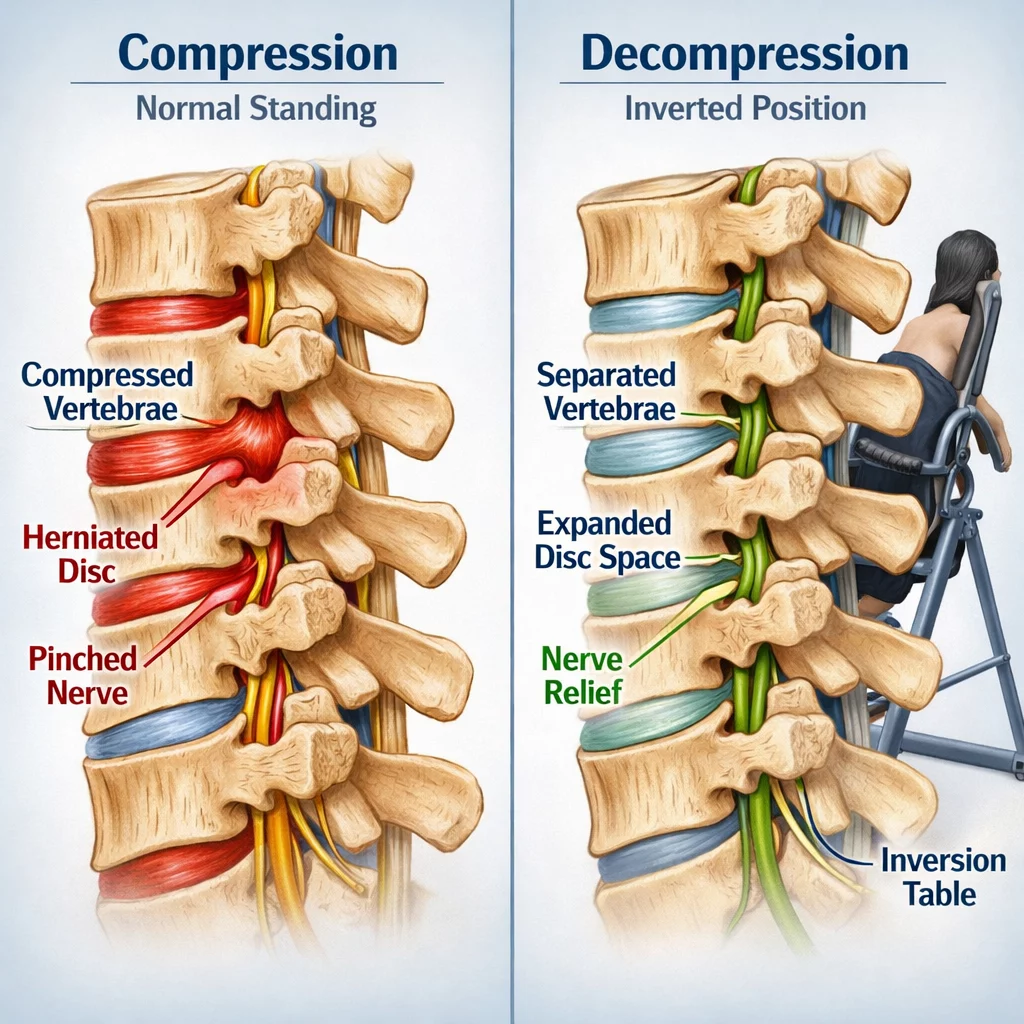
Inversion tables work by securing your ankles and tilting your body partially or fully upside down, using gravity to pull your spine in the opposite direction of normal compression. This creates a traction effect that stretches vertebrae apart, reduces pressure on spinal discs and nerves, and allows better nutrient flow to damaged areas. The decompression happens because gravity reverses its usual downward force, giving your spine temporary relief from years of compression.
Key Takeaways
- Inversion tables use gravity in reverse to decompress the spine by tilting the body at angles ranging from 20 to 90 degrees
- Spinal decompression occurs when vertebrae separate, reducing pressure on discs and nerves that cause back pain and sciatica
- Start slowly at 20-degree angles for 1-2 minutes and progress gradually over weeks to avoid dizziness or injury
- Not safe for everyone – avoid if you have glaucoma, high blood pressure, heart disease, or circulation problems
- Best results come from consistent use of 2-3 sessions daily at 60-degree angles for 3-5 minutes each
- Scientific evidence shows modest short-term relief for disc-related back pain, but limited proof of long-term benefits
- Choose FDA-registered models with UL certification for safety, stability, and proper weight capacity
- Combine with other treatments like physical therapy and exercise rather than relying on inversion alone
What Is an Inversion Table and How Does It Work?
An inversion table is a padded platform that rotates on a pivot point, allowing you to tilt backward while your ankles remain secured in padded supports. The device works by reversing the normal gravitational pull on your spine – instead of compressing downward as it does when you stand or sit, gravity pulls your upper body away from your lower body when inverted.[1]
The mechanical principle is straightforward. When you lie on the table and tilt back, your body weight creates traction along your spine. This traction gently pulls vertebrae apart, creating space between the bones. That extra space reduces pressure on the gel-like discs that cushion your vertebrae and relieves compression on nerve roots that exit the spinal column.[2]
The decompression effect happens in stages:
- At 20-30 degrees, mild traction begins to separate vertebrae slightly
- At 40-60 degrees, significant decompression occurs in the lumbar spine
- At 60-90 degrees, maximum traction affects the entire spinal column
- The stretched position allows discs to absorb more fluid and nutrients
Most therapeutic benefits occur at partial inversion between 20 and 60 degrees – you don’t need to hang completely upside down to experience relief.[3]
How Inversion Tables Create Spinal Decompression
Spinal decompression through inversion works because your spine normally carries the weight of your upper body all day. Over decades, this constant compression squeezes the discs between vertebrae, reducing their thickness and pushing disc material outward. This process causes bulging discs, herniated discs, and pinched nerves that create back pain and sciatica.[2]
When you invert, gravity reverses its effect. Your upper body weight now pulls away from your pelvis and legs instead of pressing down on them. This creates negative pressure inside the disc spaces, which has several effects:
Immediate decompression benefits:
- Vertebrae separate by 1-3 millimeters, creating more space for nerves
- Disc pressure drops, allowing bulging material to retract slightly
- Nerve roots experience less compression, reducing pain signals
- Facet joints (the small joints between vertebrae) gain better spacing
- Blood flow improves to compressed areas of the spine
The decompression also allows spinal discs to rehydrate. Discs don’t have direct blood supply – they absorb nutrients and water through a pumping action created by movement and pressure changes. Inversion creates a strong suction effect that draws fluid back into dehydrated discs.[2]
Who Should Use an Inversion Table and Why?
Inversion tables primarily help people dealing with chronic back pain caused by spinal compression issues. The most common conditions that may benefit include herniated discs, degenerative disc disease, sciatica, spinal stenosis, facet syndrome, and persistent muscle spasms in the back.[3]
Choose inversion therapy if you have:
- Chronic lower back pain that worsens with standing or sitting
- Sciatica (leg pain from pinched nerves) that radiates down one or both legs
- Morning stiffness that improves as the day progresses
- Disc problems confirmed by MRI showing bulging or herniation
- Muscle tension in the back that doesn’t respond well to stretching alone
Older adults often find inversion helpful because decades of compression have reduced disc height and created chronic pain. One study found that patients with sciatica from disc protrusion who used inversion therapy were less likely to need surgery, though the exact reduction percentage varies by individual circumstances.[4]
Avoid inversion tables if you have:
- Glaucoma or other eye pressure problems
- High blood pressure or heart disease
- History of stroke or circulation issues
- Osteoporosis or bone fractures
- Inner ear problems that affect balance
- Pregnancy or recent abdominal surgery
The safety concerns exist because inverting causes blood to rush toward your head, increasing pressure in your eyes, skull, and heart. For people with cardiovascular or eye conditions, this pressure spike can cause serious complications.[4]
How to Use an Inversion Table Safely: Step-by-Step
Safe inversion requires a gradual approach, especially for older adults who may have balance issues or underlying health conditions. Never start at steep angles or invert for long periods on your first attempt.
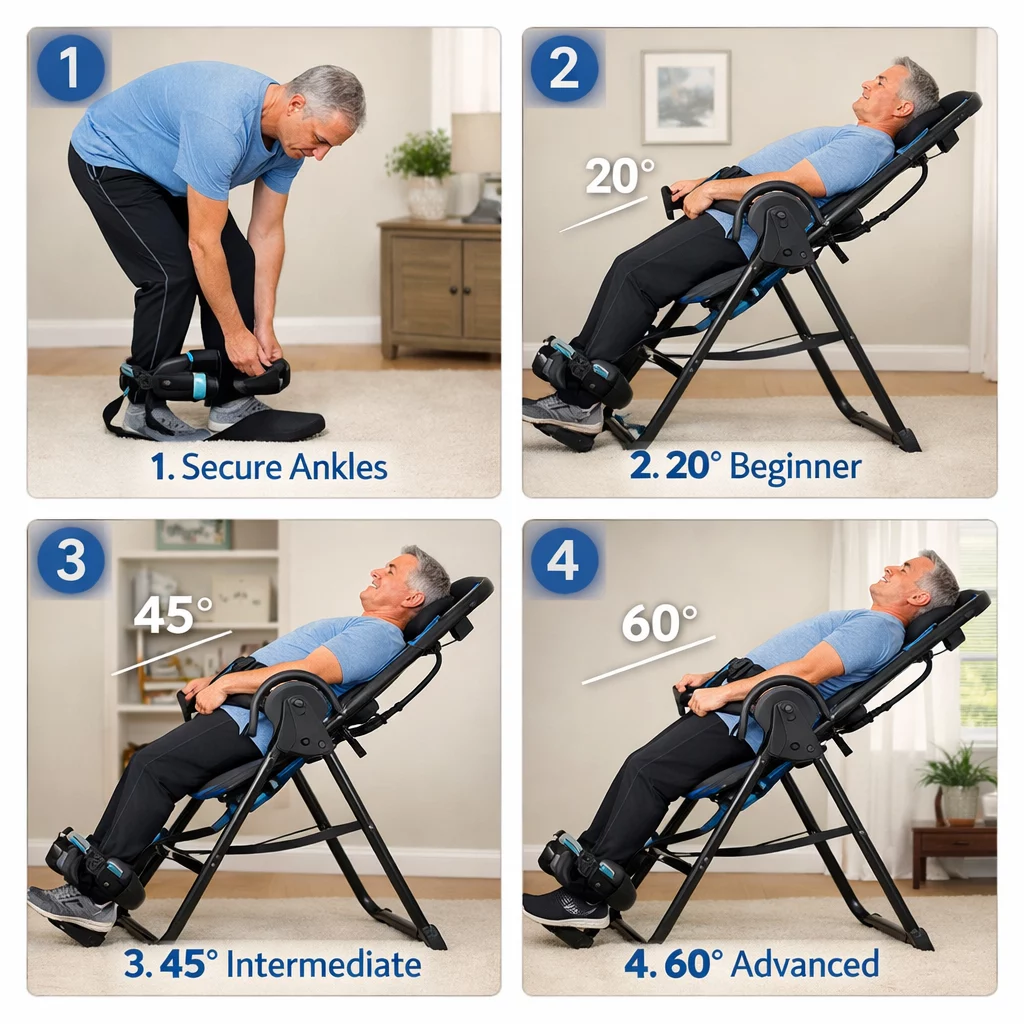
Beginner protocol (weeks 1-2):
- Adjust the table height so the pivot point aligns with your ankle height
- Secure both ankles firmly in the padded supports – they should feel snug but not painful
- Start with your arms at your sides and slowly lean back to 15-20 degrees
- Hold this position for 1-2 minutes while breathing normally
- Use the side handles to pull yourself upright slowly
- Rest for several minutes before standing up
Intermediate progression (weeks 3-4):
- Increase angle to 30-40 degrees for 2-3 minutes
- Practice twice daily, morning and evening
- Add gentle side-to-side rocking motions to increase decompression
- Raise your arms overhead to increase the stretch if comfortable
Advanced use (after 4-6 weeks):
- Progress to 60-degree angles for 3-5 minutes per session
- Use 2-3 times daily for chronic pain management
- Some users eventually reach 90 degrees, but this isn’t necessary for benefits
- Increase angle by 10-20 degrees each week based on comfort level[3][4]
Common mistakes to avoid:
- Inverting too steeply too soon causes dizziness and discourages continued use
- Staying inverted too long (over 10 minutes) increases blood pressure risks
- Getting up too quickly after inversion can cause lightheadedness
- Using the table without medical clearance if you have risk factors
Always have someone nearby during your first few sessions in case you need help returning to an upright position.
What Does the Science Say About Inversion Table Effectiveness?
The scientific evidence for inversion tables shows modest benefits for specific conditions but lacks strong support for long-term pain relief. As of 2026, research indicates that inversion therapy provides clearer short-term relief for disc-related issues than for general chronic back pain.[4]
What studies have found:
- Short-term pain reduction occurs in many users with herniated discs
- Sciatica symptoms may improve when caused by disc protrusion
- Muscle tension and spasms often decrease after regular use
- Some patients avoid surgery by combining inversion with other treatments
- Long-term benefits remain unclear due to limited high-quality research
The evidence quality remains low because most studies involve small groups and don’t follow participants for extended periods. Medical reviews from 2026 confirm that while many people report feeling better, the scientific proof doesn’t yet match the popularity of these devices.[4]
Realistic expectations:
Inversion tables work best as part of a broader treatment plan that includes physical therapy, core strengthening exercises, and proper posture habits. Using the table alone rarely solves chronic back problems permanently. Think of it as a tool for temporary relief and maintenance rather than a cure.
The decompression effect is real and measurable – studies using imaging have confirmed that vertebrae do separate during inversion. However, this separation is temporary. Once you return upright, gravity resumes its compressive force. Regular use may help maintain better disc health over time, but the benefits disappear if you stop using the table.[2]
How to Choose a Safe and Effective Inversion Table
Quality and safety features matter significantly when selecting an inversion table, especially for older adults who need stable, reliable equipment. Not all tables meet medical device standards or provide adequate support.
Essential safety features:
- FDA registration as a Class 1 medical device ensures basic safety standards
- UL certification confirms electrical and mechanical safety testing
- Weight capacity of at least 300 pounds for stability (check your specific needs)
- Precision balancing system that allows controlled rotation without sudden flips
- Padded ankle supports with secure locking mechanisms
- Sturdy steel frame with wide base for stability
- Non-slip foot platform for safe mounting and dismounting
Teeter FitSpine models are frequently recommended because they meet FDA and UL standards and include features designed for controlled, safe inversion. These tables use a precision balance system that lets you control rotation speed by shifting your arms, preventing sudden flips that could cause injury.[5][7]
Comparison of key features:
| Feature | Budget Models | Quality Models (e.g., Teeter) |
|---|---|---|
| FDA Registration | Often absent | Yes, Class 1 device |
| Weight Capacity | 250 lbs typical | 300+ lbs |
| Ankle Comfort | Basic foam | Contoured, padded supports |
| Rotation Control | Manual only | Precision balance system |
| Frame Stability | Narrow base | Wide, reinforced base |
| Warranty | 90 days-1 year | 5 years typical |
| Price Range | $100-200 | $300-500 |
Decision rule: Choose a budget model only if you’re testing whether inversion works for you and have no balance or stability concerns. Invest in a quality model if you plan regular long-term use or have any risk factors that require extra safety measures.
Look for tables with easy-to-reach handles on both sides that let you pull yourself upright without straining. Some models include heat and massage features, but these add cost without improving the core decompression function.[7]
How Often Should You Use an Inversion Table?
Frequency and duration depend on your goals and pain severity. Most experts recommend starting conservatively and building up to a regular routine based on how your body responds.
For general back health and prevention:
- Use 2-3 times per week at 30-40 degrees
- Sessions of 3-5 minutes each
- Focus on maintaining disc hydration and flexibility
- Combine with regular stretching and core exercises
For active back pain or sciatica:
- Use 2-3 times daily at 60 degrees
- Sessions of 3-5 minutes each
- Morning session helps reduce overnight compression
- Evening session relieves accumulated daily stress
- Additional midday session if pain is severe[7]
Timing considerations:
Morning use can be particularly effective because your spine compresses overnight as discs lose fluid. Inverting after waking helps restore disc height and reduce morning stiffness. Evening sessions relieve the compression accumulated during the day from sitting, standing, and moving.
Avoid inverting immediately after eating (wait 1-2 hours) or when you’re already feeling dizzy or unwell. Don’t use the table as a substitute for medical treatment – if your pain worsens or doesn’t improve after 2-3 weeks of regular use, consult a healthcare provider.[4]
Signs you’re overdoing it:
- Persistent headaches after sessions
- Increased dizziness or balance problems
- Worsening back pain instead of improvement
- Eye discomfort or vision changes
- Unusual fatigue or weakness
If you experience any of these symptoms, reduce your angle, shorten your sessions, or stop using the table until you consult a doctor.
Alternatives and Complementary Treatments to Inversion Tables
Inversion tables aren’t the only way to achieve spinal decompression or back pain relief. Several alternatives provide similar benefits with different risk profiles.
Other decompression methods:
- Hanging from a pull-up bar – provides partial decompression without full inversion, safer for those with blood pressure concerns
- Gravity boots – allow full inversion while hanging, but require more strength and balance
- Professional traction therapy – physical therapists use mechanical devices to create controlled decompression
- Decompression tables – motorized medical tables that stretch the spine horizontally without inversion
Complementary treatments that enhance inversion benefits:
- Core strengthening exercises to support the spine better
- Physical therapy to address muscle imbalances and movement patterns
- Proper ergonomics at work and home to reduce daily compression
- Anti-inflammatory diet and adequate hydration for disc health
- Regular walking and swimming to maintain spinal flexibility
Many people find the best results come from combining inversion with active rehabilitation. The table provides temporary relief and creates space for healing, while exercise and proper movement patterns address the underlying causes of compression and pain.[3]
When to choose alternatives:
Choose hanging or horizontal traction if you have mild cardiovascular concerns but still want decompression benefits. These methods create less blood pressure change than full inversion. Choose professional traction therapy if you need supervised treatment or have complex spinal conditions that require medical monitoring.
Frequently Asked Questions
How long does it take to see results from an inversion table?
Most people notice some immediate relief after their first session due to reduced muscle tension and temporary decompression. Meaningful improvement in chronic pain typically takes 2-4 weeks of consistent daily use. Disc-related conditions may require 6-8 weeks to show significant change as discs gradually rehydrate and heal.
Can inversion tables make back pain worse?
Yes, if used incorrectly or by people with certain conditions. Starting at too steep an angle, inverting too long, or using the table despite contraindications can worsen pain. Some people experience increased discomfort in the first few days as their spine adjusts to the new position. If pain worsens after a week of proper use, stop and consult a doctor.
Is 60 degrees better than 90 degrees for inversion?
For most therapeutic purposes, 60 degrees provides excellent decompression without the increased blood pressure risks of full inversion. Research shows that significant spinal separation occurs at 60 degrees, and going further doesn’t proportionally increase benefits. Full 90-degree inversion is unnecessary for most users and increases safety risks.[3]
How much does a quality inversion table cost?
Quality FDA-registered inversion tables typically cost $300-500. Budget models start around $100-150 but may lack important safety features. Premium models with additional features like heat or massage can exceed $600. Consider this a long-term investment in back health rather than a one-time purchase.
Can I use an inversion table if I have arthritis?
It depends on the type and location of arthritis. Spinal osteoarthritis may actually benefit from gentle decompression that reduces joint pressure. However, severe arthritis with bone spurs or significant joint damage requires medical clearance first. Rheumatoid arthritis affecting the neck is a contraindication due to instability risks. Always consult your doctor before starting inversion therapy with any arthritic condition.
Will inversion tables help with posture problems?
Inversion can temporarily improve posture by decompressing the spine and relieving muscle tension that pulls you into poor alignment. However, lasting posture improvement requires strengthening exercises and conscious habit changes. Use the table as part of a comprehensive approach that includes core strengthening and ergonomic adjustments.
How do I know if my inversion table is set up correctly?
The pivot point should align with your ankle height when you stand on the platform. Ankle supports should feel snug but not painful. The table should remain balanced when you’re lying flat before tilting. Test the rotation by leaning back slightly while holding the handles – it should move smoothly without sudden drops. If the table feels unstable or tips unexpectedly, readjust the height settings.
Can inversion tables help with herniated discs?
Inversion may provide relief for some herniated disc cases by reducing pressure that pushes disc material outward. The negative pressure created during inversion can help retract bulging disc material slightly. However, severe herniations or those causing significant nerve damage may require medical intervention. Use inversion as a complementary treatment alongside medical care, not as a replacement.[4]
Is it normal to feel dizzy when using an inversion table?
Mild dizziness during your first few sessions is common as your body adjusts to the blood pressure changes. This should decrease with regular use. Persistent or severe dizziness indicates you’re inverting too steeply or too long. Reduce your angle and duration. If dizziness continues, stop using the table and consult a doctor, as it may indicate an underlying condition.
How long should I wait after surgery before using an inversion table?
Wait at least 6-12 months after spinal surgery before attempting inversion, and only with explicit approval from your surgeon. Abdominal surgery requires at least 3-6 months of healing. The increased abdominal pressure during inversion can stress surgical sites. Never use an inversion table during the acute healing phase after any surgery.
Do chiropractors recommend inversion tables?
Many chiropractors recommend inversion tables as a home therapy tool to complement office treatments. The decompression effect aligns with chiropractic principles of spinal health and proper alignment. However, recommendations vary based on individual patient conditions. Some chiropractors prefer other decompression methods or consider inversion tables unnecessary if patients receive regular adjustments.
Can inversion tables reduce the need for back surgery?
Some evidence suggests that consistent inversion therapy may help certain patients avoid surgery, particularly those with sciatica from disc protrusion. However, this isn’t guaranteed and depends on the severity of the condition. Inversion works best for mild to moderate disc problems. Severe spinal conditions with progressive nerve damage typically still require surgical intervention. Use inversion as a conservative treatment option to try before considering surgery, but don’t delay necessary surgical care.[4]
Conclusion
Inversion tables work through a simple but effective mechanism: they use gravity in reverse to decompress your spine, creating space between vertebrae and reducing pressure on discs and nerves. For older adults dealing with chronic back pain, sciatica, or disc problems, these devices offer a non-invasive option for temporary relief and potential long-term maintenance when used consistently and safely.
The key to success lies in starting slowly, progressing gradually, and using the table as part of a comprehensive back health strategy rather than a standalone solution. Begin at 20-degree angles for just 1-2 minutes, and build up over weeks to 60 degrees for 3-5 minutes, 2-3 times daily. Choose an FDA-registered model with proper safety features, especially if you’re over 60 or have any health concerns.
Your next steps:
- Consult your doctor before purchasing an inversion table, especially if you have cardiovascular, eye, or bone health concerns
- Research quality models that meet FDA and UL safety standards
- Start with conservative angles and short sessions, tracking your response in a journal
- Combine inversion with core strengthening exercises and proper posture habits
- Give the therapy at least 4-6 weeks of consistent use before evaluating effectiveness
- Schedule a follow-up with your healthcare provider if pain doesn’t improve or worsens
Remember that while inversion tables provide real decompression effects, they’re tools for management rather than cures. The temporary relief they offer can be valuable for maintaining quality of life and potentially avoiding more invasive interventions, but they work best when integrated into a broader approach to spinal health that includes movement, strength, and professional guidance.
References
[1] Understanding Inversion Tables How They Work Why People Use Them And What To Know Before You Try One – https://regenerativespineandjoint.com/2025/12/29/understanding-inversion-tables-how-they-work-why-people-use-them-and-what-to-know-before-you-try-one/
[2] Inversion Table – https://nfpt.com/inversion-table/
[3] Inversion Tables For Back Pain Do They Work – https://www.doctronic.ai/blog/inversion-tables-for-back-pain-do-they-work/
[4] Teeter Fitspine Inversion Tables Review – https://www.garagegymreviews.com/teeter-fitspine-inversion-tables-review
[5] Inversion Therapy Benefits And Safety – https://teeter.com/blog/inversion-therapy-benefits-and-safety/