Last updated: April 11, 2026
Quick Answer
New materials for hardhats must pass rigorous testing under the ANSI/ISEA Z89.1 standard, which evaluates impact resistance, penetration protection, and electrical insulation. Manufacturers test helmets for top impacts (Type I) or 360-degree protection (Type II), plus electrical safety classes ranging from no protection (Class C) to 20,000-volt resistance (Class E). Every compliant hardhat carries interior labels confirming it meets these safety requirements for hardhats, and OSHA mandates this certification for construction and industrial sites in 2026.[1][2]
Key Takeaways
- ANSI/ISEA Z89.1 remains the core testing standard for hardhat materials and performance in 2026, covering impact, penetration, and electrical protection[1][2]
- Type I helmets protect against top impacts only, while Type II helmets offer 360-degree protection from side, front, and rear strikes[3][7]
- Electrical classes include Class E (20,000 volts), Class G (2,200 volts), and Class C (no electrical protection)[2][4]
- New materials like polycarbonate shells, high-density foam, and advanced impact absorbers must still pass ANSI/ISEA Z89.1 requirements before approval[5]
- OSHA’s 2026 PPE rule requires employers to evaluate hardhat fit across body types and genders, emphasizing proper suspension and chin strap systems[6][7]
- Labels inside the helmet confirm compliance—look for ANSI Z89.1 markings, Type/Class designations, and special ratings like HT (high-temperature) or LT (low-temperature)[4]
- Modern safety helmets with chin straps are replacing traditional hard hats on many sites for better fall protection and retention[3][5]
What Is the Primary Testing Standard for Safety Requirements for Hardhats?
The ANSI/ISEA Z89.1 standard is the primary benchmark that new hardhat materials must meet to satisfy safety requirements for hardhats in the United States. Published by the American National Standards Institute (ANSI) and the International Safety Equipment Association (ISEA), this standard defines performance criteria for industrial head protection, including how helmets handle impact forces, resist penetration from sharp objects, and provide electrical insulation.[1][2]
The current edition, ANSI/ISEA Z89.1-2024, remains authoritative in 2026 and covers:
- Impact resistance testing: Dropping a weighted striker onto the helmet to measure force transmission to the wearer’s head
- Penetration resistance: Driving a pointed object into the shell to ensure it doesn’t breach the interior
- Electrical insulation: Proof-testing helmets at specified voltages to confirm they protect against electrical shock
- Flammability: Verifying materials resist ignition and self-extinguish quickly
OSHA regulations 29 CFR 1910.135 (general industry) and 1926.100 (construction) require employers to provide head protection that meets ANSI/ISEA Z89.1 when workers face hazards from falling objects, electrical contact, or bumps.[2][5] This alignment means any hardhat sold for workplace use must carry the ANSI Z89.1 certification label inside the shell.
Why this matters for you: If your hardhat lacks the ANSI Z89.1 mark, it’s not compliant for most job sites. Supervisors and safety officers check these labels during inspections, and non-compliant gear can result in citations or removal from the site.
How Do Type I and Type II Classifications Affect Safety Requirements for Hardhats?
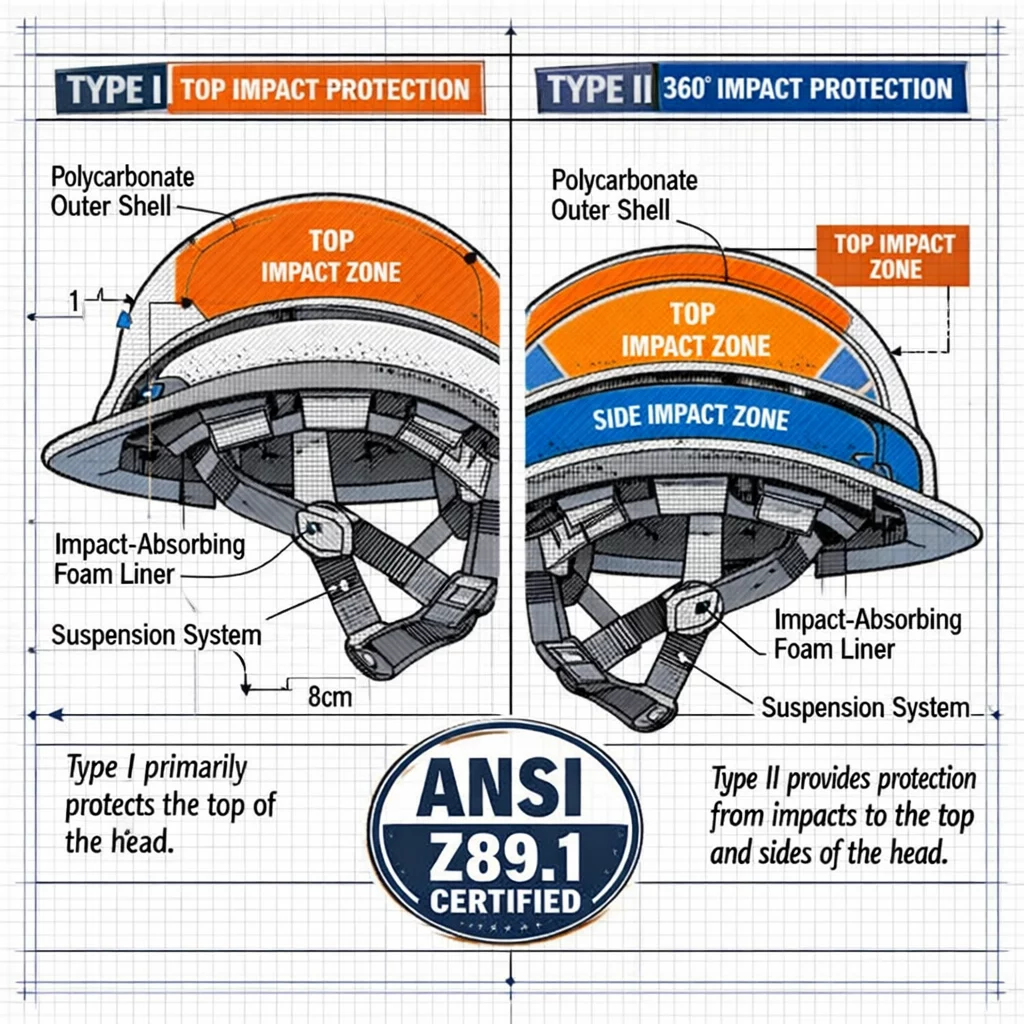
Type I and Type II classifications define the zones of protection a hardhat provides, directly impacting which safety requirements for hardhats apply to your work environment.
- Type I helmets protect against impacts to the top of the head only. They’re designed for environments where falling objects are the primary hazard and side impacts are unlikely.[1][3]
- Type II helmets offer 360-degree protection, shielding the top, sides, front, and rear of the head. These are critical for workers at risk of lateral impacts, such as swinging loads or collisions in confined spaces.[3][7]
Key Differences in Testing
| Feature | Type I | Type II |
|---|---|---|
| Impact zones tested | Top only | Top, front, rear, sides |
| Typical use cases | General construction, warehouses | High-risk sites, confined spaces, elevated work |
| Retention requirement | Suspension system | Often includes chin strap for better retention[7] |
| OSHA 2026 emphasis | Standard compliance | Preferred for fall protection scenarios[7] |
Common mistake: Assuming all hardhats provide the same protection. A Type I helmet won’t protect you if a swinging beam strikes the side of your head. Check your site’s hazard assessment—if lateral impacts are possible, Type II is the safer choice.
Real-world example: A steel erector working near crane operations switched from a Type I to a Type II helmet after a near-miss with a rotating load. The 360-degree protection gave him confidence that side impacts wouldn’t leave him vulnerable, and the chin strap kept the helmet secure when he bent over or worked at awkward angles.
What Electrical Protection Classes Must New Materials Meet?
Electrical protection classes determine how well a hardhat insulates against electrical shock, a critical component of safety requirements for hardhats in environments with live wires or high-voltage equipment.
The Three Classes
- Class E (Electrical): Proof-tested to withstand 20,000 volts. Required for utility workers, electricians, and anyone near high-voltage power lines or substations.[2][4]
- Class G (General): Tested up to 2,200 volts. Suitable for general construction and industrial sites where low-voltage electrical hazards exist.[2][4]
- Class C (Conductive): Provides no electrical protection. These helmets often feature ventilation slots and are used in environments with no electrical hazards, such as food processing or non-electrical construction tasks.[2][4]
How testing works: Manufacturers submerge helmets in water (to simulate worst-case conductivity) and apply the rated voltage. If leakage current stays below safe thresholds, the helmet passes. Class E and G helmets must also resist flame and not conduct electricity through the shell or suspension.[4]
Decision rule: Choose Class E if you work within 10 feet of power lines or electrical equipment over 2,200 volts. Opt for Class G on typical construction sites with standard electrical systems. Use Class C only when electrical hazards are absent and ventilation is a priority.
Edge case: Some workers mistakenly assume any hardhat protects against electricity. A Class C helmet with vents can actually increase risk near live wires by allowing contact. Always verify the class marking inside your helmet matches your site’s electrical hazards.
How Has OSHA’s Shift to Safety Helmets Changed Safety Requirements for Hardhats?
In late 2023, OSHA began recommending a transition from traditional hard hats to safety helmets—a design similar to climbing or cycling helmets with integrated chin straps and enhanced padding. This shift continues to reshape safety requirements for hardhats in 2026, emphasizing retention and fall protection.[3][5]
What Makes Safety Helmets Different?
- Chin straps: Keep the helmet on your head during falls, trips, or when working at heights[3][7]
- Enhanced padding: High-density foam and advanced materials like WaveCel or Koroyd absorb rotational forces and reduce concussion risk[5]
- Type II compliance: Most safety helmets meet Type II standards for 360-degree protection[7]
- Better fit: Adjustable suspension systems and sizing options accommodate diverse head shapes and sizes, addressing OSHA’s 2026 PPE fit requirements[6][7]
Why the change? Traditional hard hats can fall off during a slip or trip, leaving workers unprotected at the moment of impact. Safety helmets with chin straps stay in place, reducing head injuries from falls—a leading cause of construction fatalities.
OSHA’s 2026 guidance doesn’t ban traditional hard hats but strongly encourages safety helmets for tasks involving:
- Work at heights (scaffolding, ladders, elevated platforms)
- Confined spaces where bumps and lateral impacts are common
- High-traffic areas with moving equipment
Practical tip: If your employer hasn’t upgraded yet, ask about safety helmets during your next PPE review. Many manufacturers now offer ANSI Z89.1-compliant safety helmets at comparable prices to traditional hard hats, and the added protection is worth the investment.
What Special Environmental Ratings Do Materials Need to Pass?
Beyond impact and electrical testing, new hardhat materials must meet environmental ratings to ensure safety requirements for hardhats hold up in extreme conditions. These ratings appear as labels inside the helmet and guide workers in selecting appropriate gear.
Key Environmental Markings
- HT (High-Temperature): Materials resist deformation and maintain protection when exposed to radiant heat, molten metal splashes, or high ambient temperatures. Common in foundries, welding operations, and steel mills.[4]
- LT (Low-Temperature): Helmets preconditioned and tested at cold temperatures (often -20°F or lower) to ensure the shell doesn’t crack or become brittle. Essential for outdoor winter work, cold storage facilities, and northern climates.[4]
- HV (High-Visibility): Bright colors (fluorescent yellow, orange, lime green) and reflective strips enhance visibility in low-light conditions or high-traffic areas like roadwork zones.[4]
Testing process: For HT ratings, manufacturers expose helmets to heat sources and then perform impact tests to verify the shell hasn’t weakened. For LT ratings, helmets are chilled in freezer chambers before undergoing the same impact and penetration tests. Only materials that pass both environmental conditioning and standard ANSI tests earn the special markings.
Common mistake: Using a standard hardhat in extreme cold. Polycarbonate and some ABS plastics can crack in freezing temperatures if not rated LT. A cracked helmet fails to protect, and you might not notice the damage until it’s too late.
Choose HT if: You work near furnaces, perform welding, or handle molten materials.
Choose LT if: You work outdoors in winter or in refrigerated environments.
Choose HV if: You’re on roadways, near traffic, or in dimly lit areas where visibility is critical.
What Advanced Materials Are Being Tested for Modern Hardhats?
As safety requirements for hardhats evolve, manufacturers are testing innovative materials that go beyond traditional polycarbonate and ABS plastics. These materials must still pass ANSI/ISEA Z89.1 Type I or Type II requirements, but they offer enhanced protection against specific hazards.[5]
Emerging Materials in 2026
- Polycarbonate shells: Lightweight, impact-resistant, and durable. Polycarbonate remains the gold standard for most industrial helmets and handles both impact and penetration tests well.[5]
- High-density foam liners: Multi-density foam absorbs energy progressively, reducing peak forces transmitted to the skull. Some designs use dual-layer foam with soft outer layers for minor bumps and firm inner layers for major impacts.[5]
- Koroyd: A honeycomb-like structure that crumples on impact, dissipating energy more efficiently than traditional foam. Originally developed for cycling helmets, Koroyd is now appearing in industrial safety helmets.[5]
- WaveCel: A collapsible cellular material that flexes and glides during angled impacts, reducing rotational forces that cause concussions. WaveCel-equipped helmets are gaining traction in construction and utilities.[5]
- Carbon fiber reinforcements: Some high-end helmets incorporate carbon fiber in the shell for added strength without extra weight, useful for workers who wear helmets all day.
Testing requirements: Regardless of material, every helmet must pass the same ANSI Z89.1 impact drop tests, penetration tests, and electrical insulation tests (if rated Class E or G). Advanced materials don’t get a pass—they must meet or exceed the baseline standards.[2][5]
Real-world benefit: A utility worker using a WaveCel-equipped safety helmet reported less neck strain and fewer headaches after long shifts. The lighter weight and better impact absorption made a noticeable difference compared to his old hard hat, and the helmet still carried the ANSI Z89.1 Type II, Class E certification he needed for electrical work.
How Can You Verify a Hardhat Meets Current Safety Requirements?
Verifying that a hardhat meets safety requirements for hardhats is straightforward if you know where to look. Every compliant helmet carries labels and markings inside the shell that confirm it passed ANSI/ISEA Z89.1 testing.[1][2][4]
What to Check on the Label
- ANSI/ISEA Z89.1 marking: Confirms the helmet meets the current standard. Look for the year (e.g., Z89.1-2024) to ensure it’s a recent edition.[2]
- Type designation: Type I or Type II, indicating the zones of protection.[3]
- Class designation: Class E, G, or C, specifying electrical protection level.[2][4]
- Manufacturer name and model number: Identifies the helmet for replacement parts and warranty claims.
- Date of manufacture: Helmets degrade over time. Most manufacturers recommend replacement every 5 years from the manufacture date, or sooner if damaged.[4]
- Special ratings: HT, LT, or HV markings for environmental conditions.[4]
Quick compliance check: Flip your hardhat over and look inside. If you see “ANSI Z89.1,” a Type, and a Class, you’re good to go. If any of these are missing, the helmet isn’t compliant for OSHA-regulated sites.
Common mistake: Ignoring the manufacture date. A 10-year-old hardhat might look fine but could have UV damage or material fatigue that compromises protection. Replace helmets on schedule, even if they appear undamaged.
Edge case: Custom-painted or hydro-dipped hardhats. Aftermarket finishes can void ANSI certification if the paint or dipping process uses solvents that weaken the shell. Always verify with the manufacturer that custom finishes don’t affect compliance, and check that the ANSI label remains intact after customization.[1]
What Inspection Standards Ensure Ongoing Compliance with Safety Requirements for Hardhats?
Passing initial testing isn’t enough—hardhats must be inspected regularly to ensure they continue meeting safety requirements for hardhats throughout their service life. OSHA and ANSI guidelines recommend pre-use inspections and periodic detailed checks.[4]
Pre-Use Inspection Checklist
- Outer shell: Look for cracks, dents, gouges, or discoloration. Even small cracks can propagate under impact, reducing protection.
- Suspension system: Check webbing for fraying, tears, or loss of elasticity. The suspension absorbs impact energy, so worn straps compromise safety.
- Chin strap (if equipped): Ensure buckles function smoothly and straps aren’t stretched or damaged. A broken chin strap defeats the purpose of a safety helmet.
- Interior cushioning: Inspect foam pads for compression or deterioration. Flattened foam won’t absorb impact effectively.
- Label legibility: Confirm the ANSI marking and date are still readable. If the label is worn off, you can’t verify compliance.
When to replace immediately:
- Any visible crack or puncture in the shell
- Suspension system that’s loose, torn, or missing components
- Helmet that’s been struck by a significant impact (even if no visible damage)
- Helmet exposed to chemicals, extreme heat, or UV degradation beyond normal wear
Frequency: Perform a quick visual check before every shift. Conduct a detailed inspection monthly, and document findings if your site requires written records.
Real-world scenario: A foreman caught a cracked hardhat during a morning inspection. The worker had dropped a wrench on it the previous day but didn’t think the small crack mattered. The foreman replaced the helmet on the spot—later that week, a falling bolt struck the same worker’s head. The new helmet absorbed the impact without issue, but the cracked one likely would have failed.
How Do OSHA’s 2026 PPE Fit Requirements Affect Hardhat Selection?
Effective January 13, 2026, OSHA’s updated PPE rule (29 CFR 1910.135) requires employers to evaluate hardhats for proper fit across diverse body types, genders, and conditions such as pregnancy. This change directly impacts how safety requirements for hardhats are applied on job sites.[6][7]
What the New Rule Requires
- Fit assessments: Employers must ensure hardhats fit securely on all workers, accounting for head size, shape, and hairstyles (e.g., ponytails, braids, or head coverings).[6]
- Suspension adjustments: Helmets with adjustable suspension systems must be properly configured for each worker. A loose helmet can shift or fall off; an overly tight one causes discomfort and headaches.[6]
- Alternatives for fit issues: If standard hardhats don’t fit a worker properly, employers must provide alternative models or sizes that do.[6]
- Chin strap emphasis: For Type II safety helmets, chin straps must be adjusted to keep the helmet in place without restricting movement or breathing.[7]
Why this matters: A hardhat that doesn’t fit correctly won’t protect you. If it’s too loose, it can fall off during a fall or slip. If it’s too tight, you might avoid wearing it properly, leaving you unprotected.
Practical steps:
- Try on multiple helmet models to find one that sits level on your head without pressure points.
- Adjust the suspension system so the helmet sits about 1 inch above your eyebrows and doesn’t rock forward or backward.
- If your helmet has a chin strap, tighten it so you can fit two fingers between the strap and your chin—snug but not choking.
- If you wear a ponytail or hijab, look for helmets with extended suspension systems or rear adjustment slots that accommodate head coverings without compromising fit.
Common mistake: Accepting a poorly fitting helmet because “it’s what’s available.” OSHA’s 2026 rule puts the responsibility on employers to provide proper-fitting PPE. Speak up if your helmet doesn’t fit—it’s your right and your safety.
What Are the Most Common Mistakes Workers Make Regarding Hardhat Safety Requirements?
Even with clear standards, workers and employers sometimes make errors that undermine safety requirements for hardhats. Recognizing these mistakes helps you stay compliant and protected.
Top Mistakes to Avoid
- Wearing a damaged helmet: Continuing to use a cracked or dented hardhat because it “still looks okay.” Damage compromises structural integrity, and the helmet may fail under impact.[4]
- Ignoring the expiration date: Using a helmet beyond its 5-year service life. UV exposure and material fatigue reduce protection over time, even without visible damage.[4]
- Removing the suspension system: Some workers remove or modify the suspension to make the helmet more comfortable. The suspension is critical for absorbing impact—without it, the helmet is useless.[4]
- Choosing the wrong class: Wearing a Class C (non-electrical) helmet near live wires. Always match the class to your site’s electrical hazards.[2]
- Skipping the chin strap: Not using the chin strap on a Type II safety helmet. The strap keeps the helmet on during falls, which is the whole point of upgrading from a traditional hard hat.[7]
- Aftermarket modifications: Adding stickers, drilling holes, or applying unauthorized paint. These can weaken the shell or void ANSI certification.[1]
- Assuming all hardhats are the same: Grabbing any helmet from the rack without checking the Type and Class. Different jobs require different protection levels.[3]
Quick fix: Make label-checking a habit. Before you put on a hardhat, glance inside to confirm it’s the right Type and Class for your task. If you’re unsure, ask your supervisor or safety officer.
FAQ
What does ANSI Z89.1 certification mean for hardhats?
ANSI Z89.1 certification confirms a hardhat has passed standardized tests for impact resistance, penetration protection, and electrical insulation. It’s the baseline requirement for workplace head protection in the U.S.[1][2]
How often should hardhats be replaced?
Replace hardhats every 5 years from the manufacture date, or immediately if they show cracks, dents, or have sustained a significant impact. UV exposure and wear degrade materials over time.[4]
What’s the difference between Type I and Type II hardhats?
Type I hardhats protect against top impacts only. Type II hardhats provide 360-degree protection, including sides, front, and rear. Choose Type II for environments with lateral impact risks.[3][7]
Can I use a Class C hardhat near electrical equipment?
No. Class C hardhats offer no electrical protection and often have vents that increase conductivity risk. Use Class G (up to 2,200 volts) or Class E (up to 20,000 volts) near electrical hazards.[2][4]
Are safety helmets with chin straps required in 2026?
OSHA recommends safety helmets with chin straps for fall protection and retention but doesn’t ban traditional hard hats. Many sites are adopting helmets for better safety, especially for elevated work.[3][7]
What do HT and LT markings on a hardhat mean?
HT (high-temperature) indicates the helmet resists heat and maintains protection in hot environments. LT (low-temperature) means it’s tested for cold conditions and won’t crack in freezing temperatures.[4]
Can I paint or customize my hardhat?
Custom paint or hydro-dipping can void ANSI certification if solvents weaken the shell. Always verify with the manufacturer that finishes don’t affect compliance, and ensure the ANSI label remains intact.[1]
How do I know if my hardhat fits properly?
A properly fitting hardhat sits level about 1 inch above your eyebrows, doesn’t rock forward or backward, and the suspension system is snug but not tight. Adjust straps and suspension to eliminate pressure points.[6]
What should I do if my hardhat is damaged?
Replace it immediately. Even minor cracks or dents can compromise protection. Don’t wait for a major impact to discover your helmet won’t protect you.[4]
Do all construction sites require Type II hardhats?
Not all, but OSHA’s 2026 guidance emphasizes Type II helmets for sites with lateral impact risks, confined spaces, or fall hazards. Check your site’s hazard assessment to determine the required Type.[7]
What materials are used in modern safety helmets?
Modern helmets use polycarbonate shells, high-density foam, and advanced materials like Koroyd or WaveCel for better impact absorption. All materials must still pass ANSI Z89.1 testing.[5]
How do I check if a hardhat is ANSI-compliant?
Look inside the helmet for the ANSI/ISEA Z89.1 label, along with Type (I or II) and Class (E, G, or C) designations. If these markings are missing, the helmet isn’t compliant.[2][4]
Conclusion
Understanding the testing standards and safety requirements for hardhats isn’t just about compliance—it’s about protecting your life on the job. The ANSI/ISEA Z89.1 standard ensures every hardhat you wear has been rigorously tested for impact resistance, penetration protection, and electrical insulation. Whether you need a Type I helmet for general construction or a Type II safety helmet with a chin strap for elevated work, the right choice depends on your site’s specific hazards.
In 2026, the shift toward modern safety helmets with enhanced retention and advanced materials reflects a growing commitment to reducing head injuries. OSHA’s updated PPE fit requirements mean employers must provide helmets that fit properly across all body types, and workers have the right to speak up if their gear doesn’t meet their needs.
Take action today:
- Check your hardhat’s label to confirm it’s ANSI Z89.1-compliant and matches your job’s Type and Class requirements.
- Inspect your helmet before every shift for cracks, worn suspension, or other damage.
- Replace helmets that are over 5 years old or have been impacted, even if they look fine.
- Ask your employer about upgrading to a Type II safety helmet if your work involves fall risks or lateral impacts.
- Adjust the fit so your helmet sits securely and comfortably—a helmet that doesn’t fit won’t protect you.
Your hardhat is your first line of defense against one of the most common and serious workplace hazards. Make sure it’s up to the task by understanding the standards, choosing the right protection, and maintaining your gear properly. Stay safe out there.
References
[1] Osha Hard Hat Requirements – https://hydrodippedhardhats.com/blogs/the-custom-hard-hat-blog/osha-hard-hat-requirements
[2] Osha Head Protection Requirements – https://www.newreachglobal.com/osha-head-protection-requirements/
[3] Hard Hats Vs. Safety Helmets 2026 – https://rodenosales.com/blog/hard-hats-vs.-safety-helmets-2026
[4] Safety Helmet Shib – https://www.osha.gov/sites/default/files/publications/SAFETY_HELMET_SHIB.pdf
[5] From Hard Hats To Helmets The Evolution Of Head Protection In The Workplace – https://concretefactsmagazine.com/2026/04/01/from-hard-hats-to-helmets-the-evolution-of-head-protection-in-the-workplace/
[6] New Osha Rule Addressing Personal Protective Equipment In Construction – https://www.bernsteinshur.com/insights-events/new-osha-rule-addressing-personal-protective-equipment-in-construction/
[7] Osha Ppe Requirements Construction 2026 – https://taylorsafetysupplies.com/osha-ppe-requirements-construction-2026/