Last updated: April 10, 2026
Quick Answer
Terro Indoor Ant Bait works by attracting foraging ants to a sweet liquid containing 5.4% borax (sodium tetraborate decahydrate). Worker ants consume the bait and carry it back to their colony, sharing it with other ants and the queen. The borax disrupts their digestive systems over several days, eliminating the entire colony rather than just the ants you see.
Key Takeaways
- Active ingredient is borax at 5.4%, which is low-toxicity for humans and pets but lethal to ants through digestive system disruption
- Expect MORE ants initially as worker ants recruit nestmates to the food source before the colony dies off
- Full colony elimination takes 10-14 days depending on colony size and number of nests
- Place stations near ant trails on flat surfaces, using multiple stations for better coverage (one station covers up to 10 feet)
- Don’t disturb the stations during active feeding, even when ant activity increases dramatically
- Remove competing food sources like crumbs and spills to make the bait more attractive
- Stations last up to 3 months once opened, with a stay-fresh seal keeping liquid effective
- Works on multiple ant species including ghost ants, though some species may take longer to eliminate
What Is the Active Ingredient in Terro Indoor Ant Bait?
The active ingredient in Terro Indoor Ant Bait is sodium tetraborate decahydrate, commonly known as borax, at a concentration of 5.4%. This naturally occurring mineral compound is mixed with a sweet liquid attractant that draws ants to feed.
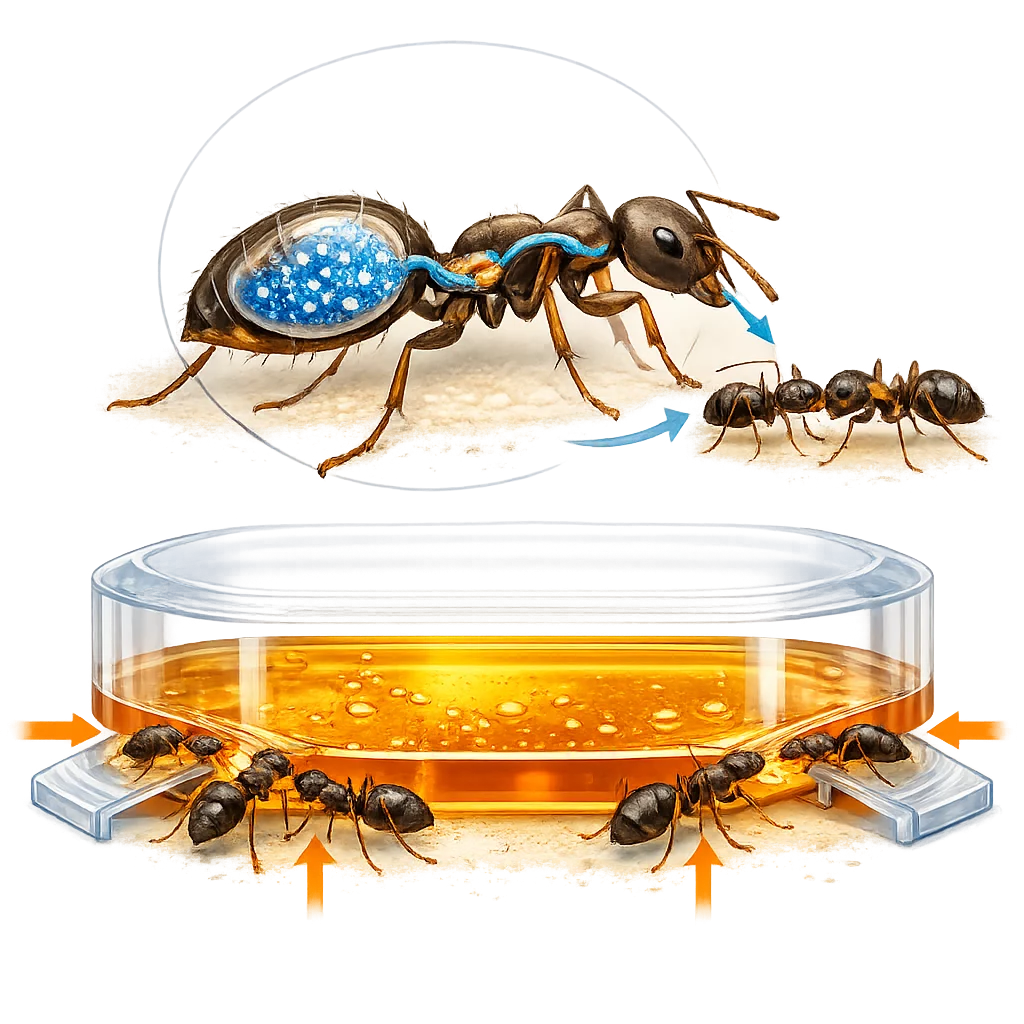
Borax works specifically on insects by interfering with their digestive systems and metabolic processes. When ants consume the bait, the borax gradually damages their stomach lining and disrupts their ability to process nutrients. The key advantage is that borax acts slowly enough that worker ants don’t die immediately at the bait station.
Why slow-acting matters: If ants died instantly after eating the bait, only the foraging workers would be eliminated while the queen and rest of the colony remained safe in the nest. The delayed action gives workers time to return home and share the poisoned food through a process called trophallaxis (mouth-to-mouth feeding), spreading the toxin throughout the colony.
For humans and pets, borax has relatively low toxicity. The concentration used in Terro baits is designed to be lethal to insects while posing minimal risk to larger animals. That said, the stations should still be placed where children and pets can’t easily access them, and hands should be washed after handling.
Common mistake: Some people worry the bait isn’t working because it seems “too safe” for humans. The reality is that insects have fundamentally different digestive systems and body chemistry than mammals, making borax highly effective against ants while remaining relatively benign for household use.
How Do Ants Find and Consume Terro Bait?
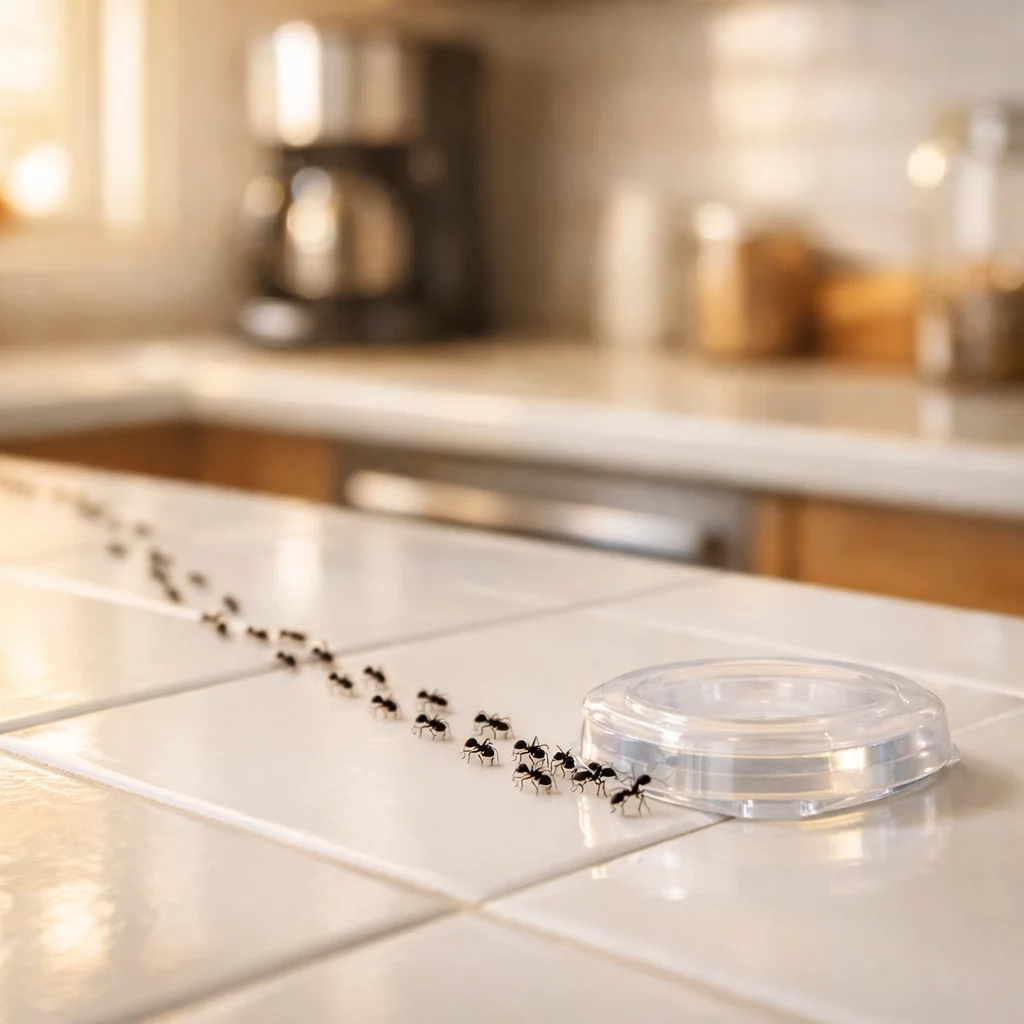
Ants find Terro bait through their constant foraging behavior and are attracted by the sweet liquid formulation inside the stations. Scout ants searching for food sources detect the sugar-based attractant and begin feeding at the station’s entry points.
Once a scout ant discovers the bait, it consumes some of the liquid and returns to the colony while laying down a chemical pheromone trail. This trail acts as a roadmap for other worker ants, who follow the scent directly to the food source. As more ants feed and travel the same path, the pheromone trail becomes stronger, recruiting even more workers.
The feeding process:
- Scout ants locate the bait station through random foraging
- They consume liquid bait and fill their crops (a storage stomach)
- Ants deposit pheromones while returning to the nest
- Nestmates follow the chemical trail to the food source
- Multiple ants feed simultaneously at station entry points
- Workers carry bait back in their bodies to share with the colony
The liquid formulation is crucial because it allows ants to easily consume and transport the bait. Unlike solid baits that require ants to break down food particles, liquid bait can be quickly ingested and carried in the ant’s crop. Back at the nest, workers regurgitate the liquid to feed larvae, other workers, and most importantly, the queen.
Choose liquid bait if: You’re dealing with sugar-feeding ant species (the most common household invaders) and need the bait to spread quickly through the colony. The liquid format ensures maximum sharing among colony members.
Why Does Ant Activity Increase After Placing Terro Bait?
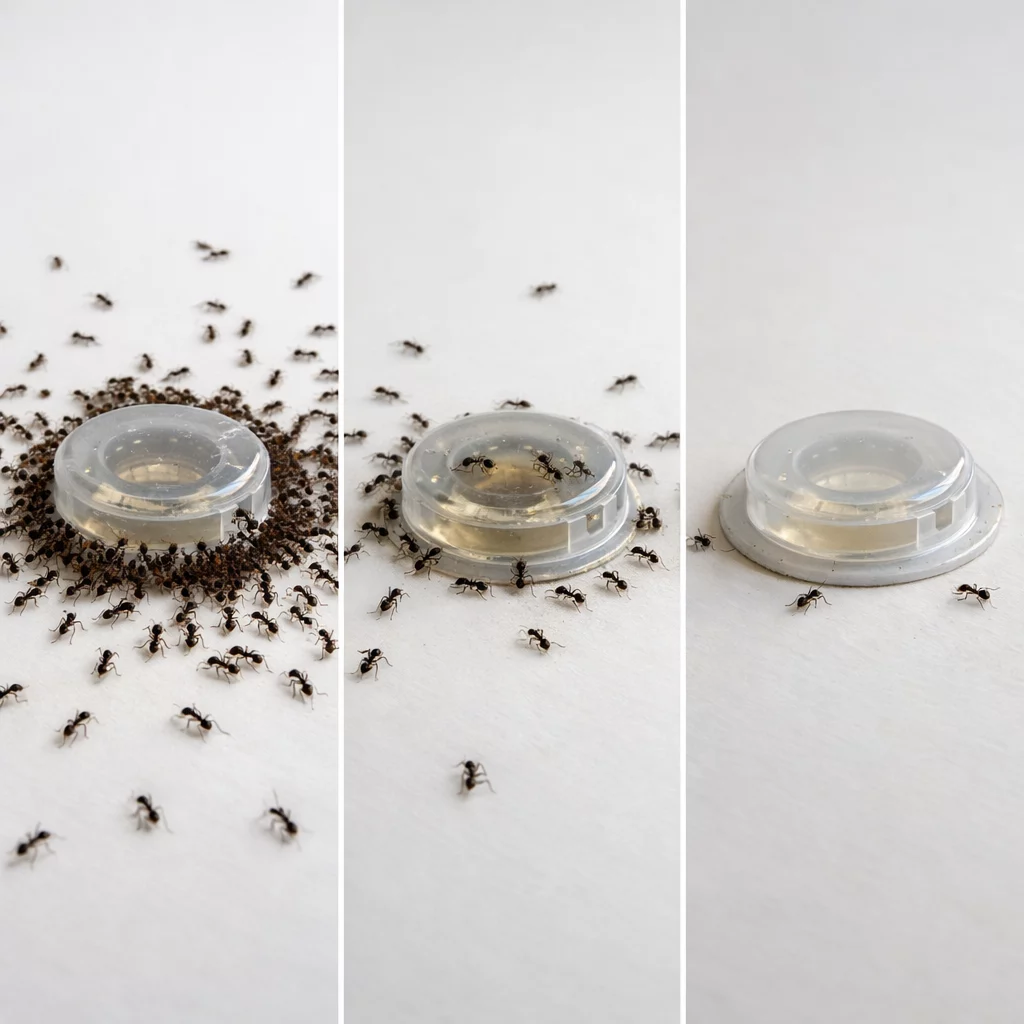
Ant activity increases dramatically after placing Terro bait because the pheromone trails recruit more and more workers to what they perceive as an abundant food source. This surge in visible ants is actually a sign the bait is working correctly, not a sign of failure.
When the first ants discover the bait and lay pheromone trails, they’re essentially calling every available forager to come feast. The colony responds by sending out maximum workforce to gather as much of this “food” as possible before it disappears. You might see dozens or even hundreds of ants where you previously only noticed a few.
What’s happening during the surge:
- Day 1-3: Ant traffic increases as pheromone trails strengthen
- Day 3-5: Peak activity with maximum ants feeding at stations
- Day 5-7: Activity begins to decline as ants start dying
- Day 7-14: Gradual reduction until ants disappear completely
This initial increase can be alarming, especially when you’re already frustrated with an ant problem. Many people make the mistake of removing the bait stations or spraying the ants during this phase, which completely undermines the treatment. The goal isn’t to kill the ants you see—it’s to kill the colony you don’t see.
Critical rule: Leave the bait stations undisturbed during heavy feeding activity, even if it looks like the problem is getting worse. Resist the urge to clean up the ant trails or spray insecticide. Every ant that feeds and returns to the nest is delivering poison to the colony.
The surge typically lasts 3-5 days before you’ll notice activity starting to decline. If you’re placing baits in a high-traffic area like a kitchen, consider doing it before a weekend when you can tolerate the temporary increase in visible ants.
How Long Does It Take for Terro Bait to Eliminate an Ant Colony?
Complete colony elimination with Terro bait takes between 10 and 14 days on average, though you should see declining ant activity starting around day 5-7. The timeline varies based on colony size, number of nests, and how many bait stations you’ve deployed.
The two-week timeframe reflects the biology of colony poisoning. Worker ants need time to consume the bait, return to the nest, share it with nestmates, and for the borax to take effect. The queen must also consume enough poisoned food to die, which happens through the feeding chain as workers regurgitate bait to her.
Factors that affect elimination speed:
- Colony size: Larger colonies with thousands of workers take longer than small colonies
- Number of nests: Some ant species maintain multiple satellite nests, extending treatment time
- Bait station placement: More stations near active trails speed up the process
- Competing food sources: Crumbs and spills reduce bait attractiveness and slow results
- Ant species: Some species are more attracted to the bait formulation than others
For ghost ants specifically, the timeline can extend to the full 14 days or slightly longer because they often maintain multiple nesting sites. Each nest needs to be exposed to the bait through the foraging network, which takes time.
Timeline expectations:
| Days | What to Expect |
|---|---|
| 1-3 | Dramatic increase in visible ant activity |
| 3-5 | Peak feeding with maximum ants at stations |
| 5-7 | Noticeable decline in ant numbers |
| 7-10 | Significant reduction, occasional stragglers |
| 10-14 | Complete elimination or near-zero activity |
If you still see significant ant activity after 14 days, it usually means one of three things: the colony is exceptionally large, there are multiple colonies, or competing food sources are reducing bait consumption. In these cases, add more bait stations and ensure your kitchen is spotlessly clean.
Where Should You Place Terro Indoor Ant Bait Stations?
Place Terro bait stations on flat surfaces directly along ant trails, near entry points, and in areas where you’ve seen ant activity. Each station provides coverage for approximately 10 feet, so use multiple stations for larger infestations or multiple problem areas.
The most effective placement strategy is to observe where ants are traveling before you set out stations. Ants follow consistent paths between their nest and food sources, and placing bait directly on these highways ensures maximum discovery and feeding.
Best placement locations:
- Along baseboards where walls meet floors (common ant highways)
- Near windows and doors where ants enter from outside
- Under kitchen appliances like refrigerators, stoves, and dishwashers
- In corners where you’ve seen ant activity
- Near sinks and other water sources
- Along countertop edges (place on floor below, not on food prep surfaces)
The stations must sit on flat, level surfaces so the liquid bait doesn’t spill. Avoid placing them on carpets or uneven flooring where they might tip over. While the stations are designed to contain the liquid, a tipped station can leak.
Placement strategy for different scenarios:
- Light infestation: 2-3 stations near the main ant trail
- Moderate infestation: 4-6 stations covering multiple entry points and trails
- Heavy infestation: 6+ stations throughout affected areas, replaced as needed
Don’t place stations directly on kitchen counters or food preparation surfaces. Instead, put them on the floor below where you see ants climbing up, or in cabinets if that’s where the activity is concentrated.
Common mistake: Placing stations in random locations instead of along actual ant trails. Ants won’t go out of their way to find bait—you need to put it where they’re already traveling. Spend 10 minutes watching ant movement before placing stations.
How Do You Set Up Terro Indoor Ant Bait Stations?
Setting up Terro Indoor Ant Bait stations requires only breaking off the activation tab to open the entry holes—no scissors or tools needed. The improved design features a snap-off tab that opens when you hold the station vertically and twist.
The stations come pre-filled with liquid bait and sealed to maintain freshness until use. Each station has a stay-fresh seal that keeps the bait effective for up to 3 months once activated, though most infestations resolve well before that timeframe.
Step-by-step setup:
- Identify ant trails by observing where ants are traveling in your home
- Hold the station vertically with the tab at the top
- Twist and snap off the tab to open the entry holes (no scissors required)
- Place the station flat directly on the ant trail or near high-activity areas
- Set out multiple stations spaced along trails and near entry points
- Leave undisturbed for the entire treatment period, even during heavy ant activity
The stations have multiple entry holes that allow several ants to feed simultaneously. Don’t try to enlarge these holes or modify the station—the design is optimized for ant access while minimizing spill risk.
Setup tips:
- Place stations before bedtime so ants can feed overnight without disturbance
- Use all six stations from the pack if you have a moderate to heavy infestation
- Write the placement date on stations with a marker to track how long they’ve been out
- Keep the product packaging for reference on active ingredients and safety information
Once placed, resist the urge to move stations around. Ants establish pheromone trails to specific locations, and moving a station breaks that connection. If you need to adjust placement, do it within the first few hours before strong trails develop.
Edge case: If you have very small children or curious pets, place stations inside cabinets or behind appliances where they’re accessible to ants but not to little hands or paws. The bait has low toxicity, but prevention is always better than treatment.
What Should You Do While the Bait Is Working?
While Terro bait is working, leave the stations completely undisturbed, avoid spraying insecticides near the bait, and eliminate competing food sources by keeping surfaces clean. Your main job during the treatment period is to do nothing that interferes with ants feeding and returning to their colony.
The hardest part of using bait stations is resisting the urge to “help” the process along. When you see dozens of ants swarming the stations, every instinct tells you to grab the spray bottle or wipe them up. Don’t. Those ants are doing exactly what you want—carrying poison back to kill the colony.
Do these things:
- Keep surfaces clean by wiping up spills and crumbs immediately
- Store food in sealed containers to eliminate competing food sources
- Take out garbage regularly to reduce alternative food options
- Leave bait stations in place even during peak ant activity
- Monitor activity levels to track progress over the 10-14 day period
- Add more stations if you discover new ant trails
Don’t do these things:
- Don’t spray insecticide near bait stations (it repels ants from the bait)
- Don’t wipe up ant trails during active feeding (you’ll disrupt pheromone paths)
- Don’t move stations once ants have established trails to them
- Don’t remove stations early just because ant activity has decreased
- Don’t place stations on countertops where food is prepared
The clean kitchen rule is particularly important. If ants have access to crumbs, spills, and open food containers, they’ll split their foraging efforts between those sources and your bait stations. You want 100% of their attention on the poisoned bait.
Decision rule: If ant activity hasn’t decreased at all after 7 days, add 2-3 more bait stations and do a thorough kitchen cleaning. The issue is usually either insufficient bait access or too many competing food sources, not bait failure.
Some people worry about the bait drying out, but the liquid stations are designed to maintain moisture for up to 3 months. If you notice a station is empty (ants consumed all the liquid), replace it with a fresh one. Heavy infestations may require station replacement every few weeks.
Does Terro Indoor Ant Bait Work on All Ant Species?
Terro Indoor Ant Bait works effectively on sugar-feeding ant species, which includes most common household invaders like odorous house ants, pavement ants, acrobat ants, and ghost ants. However, it’s less effective on protein-preferring species like carpenter ants during certain times of year.
The sweet liquid formulation specifically targets ants that forage for carbohydrates and sugars to feed their colony. These species make up the vast majority of indoor ant problems, which is why Terro maintains such strong market performance with over 100,000 monthly sales on Amazon as of 2026.
Ant species that respond well to Terro:
- Odorous house ants (the most common indoor pest)
- Pavement ants (often enter through foundation cracks)
- Ghost ants (tiny, pale ants common in kitchens)
- Acrobat ants (named for raising their abdomen when disturbed)
- Argentine ants (form super-colonies with multiple queens)
- Pharaoh ants (small, yellow ants that prefer warm areas)
Species that may need alternative baits:
- Carpenter ants during spring (prefer protein when raising brood)
- Fire ants (more aggressive, often need specialized treatment)
- Harvester ants (primarily outdoor species, prefer seeds)
Even within responsive species, results can vary. Ghost ants, for example, often maintain multiple nesting sites, which extends the elimination timeline to the full 14 days or longer. The bait still works, but patience is required as the poison spreads through the entire colony network.
Choose Terro liquid bait if: You see ants in your kitchen, bathroom, or other indoor areas and they’re attracted to sweet foods or spills. If you notice ants ignoring the bait after 2-3 days, you might be dealing with a protein-preferring species or a colony in protein-feeding mode.
The seasonal feeding preferences of ants also matter. Many species shift between sugar and protein preferences based on colony needs. In spring when raising brood, they need more protein. In summer and fall, they focus on carbohydrates for energy. This is why Terro works best during the warmer months when sugar-feeding behavior dominates.
Can You Use Terro Bait Safely Around Children and Pets?
Terro Indoor Ant Bait can be used around children and pets with basic precautions because the 5.4% borax concentration has low toxicity for mammals, but the stations should be placed where they can’t be easily accessed or tampered with. The enclosed station design provides an additional safety layer by containing the liquid.
The borax in Terro bait would need to be consumed in significant quantities to cause harm to a child or pet. A single bait station contains approximately 1 ounce of liquid, and the borax concentration is relatively low. That said, ingestion should still be avoided, and the product should be treated as you would any household cleaning product.
Safety precautions:
- Place stations behind appliances or in areas children and pets don’t access
- Use cabinet placement for homes with toddlers or curious pets
- Don’t place on countertops or other surfaces where food is prepared
- Wash hands after handling stations during setup
- Keep packaging with safety information and poison control number
- Monitor placement areas to ensure stations haven’t been disturbed
The enclosed station design prevents direct contact with the liquid bait under normal use. Ants enter through small holes that are too small for fingers or paws. However, if a station is crushed or chewed open, the liquid could be accessed.
If ingestion occurs:
- Read the product label for specific first aid instructions
- Contact poison control at 1-800-222-1222 immediately
- Have the product packaging available to provide ingredient information
- Do not induce vomiting unless instructed by medical professionals
For pets, the risk is similarly low but not zero. Dogs are more likely than cats to investigate and potentially chew on bait stations. If your dog has a history of eating non-food items, place stations in areas the dog can’t reach, such as inside cabinets or behind heavy appliances.
Edge case for pet owners: If you have a small dog (under 10 pounds) or a pet with existing health issues, consider placing stations inside cabinets or using alternative ant control methods. While toxicity is low, smaller animals are more vulnerable to any chemical exposure.
The “Made in USA” designation on Terro products also means they’re manufactured under U.S. safety and quality standards, which provides additional assurance about ingredient consistency and product safety.
What Are Common Mistakes When Using Terro Indoor Ant Bait?
The most common mistake when using Terro Indoor Ant Bait is removing the stations or spraying insecticide during the initial surge in ant activity, which prevents the bait from reaching the colony. Other frequent errors include placing too few stations, putting them in wrong locations, and not eliminating competing food sources.
Understanding these mistakes helps you avoid them and ensures the bait works as designed. Most “bait failures” are actually user errors that prevent the product from functioning properly.
Top mistakes and how to avoid them:
1. Panicking during the ant surge
- The mistake: Removing stations when ant activity increases dramatically
- Why it fails: You’re stopping the poison delivery before it reaches the colony
- The fix: Leave stations in place for the full 10-14 days, even during peak activity
2. Using too few stations
- The mistake: Placing only one or two stations for a moderate to heavy infestation
- Why it fails: Limited bait access slows colony exposure and extends treatment time
- The fix: Use 4-6 stations for typical infestations, more for severe problems
3. Wrong placement locations
- The mistake: Putting stations in random spots instead of on ant trails
- Why it fails: Ants won’t find the bait if it’s not where they’re already traveling
- The fix: Observe ant movement for 10 minutes and place stations directly on their paths
4. Spraying insecticide near bait
- The mistake: Using ant spray around bait stations to “speed up” the process
- Why it fails: Insecticide repels ants from the area, preventing bait consumption
- The fix: Choose either spray (kills visible ants only) or bait (kills colony), not both
5. Not cleaning up food sources
- The mistake: Leaving crumbs, spills, and open food available while baiting
- Why it fails: Ants split their foraging between real food and bait, slowing poison spread
- The fix: Keep kitchen spotless during treatment to make bait the only attractive option
6. Moving stations around
- The mistake: Relocating stations after ants have established pheromone trails
- Why it fails: Breaks the chemical trail connection and confuses foraging patterns
- The fix: Choose placement carefully and leave stations undisturbed
7. Removing stations too early
- The mistake: Taking up stations as soon as ant activity decreases
- Why it fails: Colony may not be fully eliminated, leading to resurgence
- The fix: Leave stations in place for the full 14 days, even if ants seem gone
8. Expecting overnight results
- The mistake: Judging bait effectiveness after just 1-2 days
- Why it fails: Colony elimination is a biological process that takes time
- The fix: Set realistic expectations for 10-14 day treatment period
The spray-and-bait combination mistake deserves special attention because it’s so common. Many people think using both methods will work faster, but insecticides actually sabotage bait effectiveness. If you’ve already sprayed, wait 2-3 days before placing bait stations so the repellent effect wears off.
Frequently Asked Questions
How quickly do ants find Terro bait after placement? Ants typically discover Terro bait within 2-24 hours of placement, depending on how close the station is to their established trails. Stations placed directly on active ant paths are usually found within hours, while those in less trafficked areas may take longer.
Can you use Terro bait in bathrooms and bedrooms? Yes, Terro Indoor Ant Bait works in any indoor location where you see ant activity, including bathrooms, bedrooms, and living areas. Place stations on flat surfaces near where ants are entering or traveling, following the same placement guidelines as kitchen use.
What should you do if ants ignore the bait? If ants ignore Terro bait after 48 hours, ensure you’ve eliminated competing food sources and the station is placed directly on an ant trail. Some ant species or colonies in protein-feeding mode may not be attracted to sweet liquid bait and require alternative products.
How many bait stations should you use for one room? Use 2-3 bait stations for a single room with light to moderate ant activity, placing them near entry points and along visible ant trails. For heavy infestations or larger rooms, use 4-6 stations spaced approximately 10 feet apart.
Is it normal for the bait liquid to look cloudy or separated? Yes, some separation or cloudiness in Terro bait is normal and doesn’t affect effectiveness. The bait remains effective for up to 3 months once opened, and ants will still be attracted to it regardless of appearance changes.
Can you use Terro bait outdoors? Terro Indoor Ant Bait is designed for indoor use, but the company makes separate outdoor bait stations specifically formulated for exterior conditions. Outdoor stations are weather-resistant and contain formulations that withstand temperature variations and moisture.
What happens if a bait station tips over? If a Terro bait station tips over, carefully stand it upright and wipe up any spilled liquid with paper towels. The station design minimizes spills, but if significant liquid escapes, replace it with a fresh station and ensure the new one is on a level surface.
Should you replace bait stations if they’re still full? Replace bait stations after 3 months even if liquid remains, as the bait effectiveness decreases over time. However, if ants have consumed all the liquid before 3 months and activity continues, replace the station immediately with a fresh one.
Can you use Terro bait if you have a septic system? Yes, Terro Indoor Ant Bait is safe for homes with septic systems. The small amount of borax in the bait won’t harm septic bacteria when disposed of normally. Don’t pour large quantities directly into drains, but normal use and disposal pose no septic risk.
Why do some ants die near the bait station? Some ants may die near bait stations because they consumed a lethal dose and didn’t make it back to the colony, or they’re part of the initial die-off as the poison takes effect. This is normal and doesn’t indicate the bait isn’t working—most ants will successfully return to share the bait before dying.
How do you dispose of used bait stations? Dispose of used Terro bait stations in household trash once the treatment period is complete or the station is empty. Wrap used stations in newspaper or place in a sealed bag to prevent any remaining liquid from leaking, and keep out of reach of children and pets until trash pickup.
Can Terro bait eliminate multiple ant colonies? Yes, Terro bait can eliminate multiple ant colonies if foragers from different colonies find and consume the bait. However, this extends the treatment timeline since each colony needs sufficient exposure. Use more bait stations and expect treatment to take the full 14 days or slightly longer.
Conclusion
Terro Indoor Ant Bait eliminates ant colonies through a simple but effective mechanism: attracting worker ants to a sweet liquid containing 5.4% borax, which they consume and carry back to share with their entire colony, including the queen. The slow-acting poison allows time for widespread distribution throughout the nest, resulting in complete colony elimination rather than just killing the ants you see on your counters.
The key to success is understanding and accepting the process. That dramatic surge in ant activity during the first 3-5 days isn’t a sign of failure—it’s proof the bait is working exactly as designed. Those dozens of ants swarming the stations are delivering poison to their nestmates, and within 10-14 days, your ant problem should be completely resolved.
Your action plan:
- Observe ant trails for 10 minutes to identify the best placement locations
- Set out 4-6 bait stations along trails, near entry points, and in high-activity areas
- Clean your kitchen thoroughly to eliminate competing food sources
- Leave stations undisturbed for the full 14 days, even during peak ant activity
- Avoid using sprays or other insecticides that will interfere with bait effectiveness
- Monitor progress by tracking ant activity levels over the two-week period
- Replace empty stations if ants consume all the liquid before the colony is eliminated
For busy moms dealing with the frustration of kitchen ant invasions, Terro Indoor Ant Bait offers a hands-off solution that works while you focus on everything else demanding your attention. Set the stations, resist the urge to interfere, and let the ants do the work of eliminating their own colony. Within two weeks, you’ll have your kitchen back without the need for repeated spraying or constant vigilance.
The product’s market leadership—with over 100,000 monthly sales and a 4.6-star rating—reflects its effectiveness when used correctly. Success comes down to proper placement, patience during the initial ant surge, and maintaining a clean environment that makes the bait the most attractive food source available.