Last updated: April 8, 2026
Quick Answer
For food factory operations at -15°C to -20°C, nitrile disposable gloves outperform latex due to superior cold flexibility, better puncture resistance, and enhanced body heat retention. Standard thin disposable gloves in either material are not specifically rated for prolonged extreme cold exposure, but nitrile maintains dexterity and barrier protection better than latex at these temperatures. For extended work in this temperature range, insulated nitrile-dipped gloves (not purely disposable) provide the most reliable protection.
Key Takeaways
- Nitrile retains flexibility at -15°C to -20°C better than latex, which becomes stiff and brittle in extreme cold
- Standard disposable gloves (both latex and nitrile) lack specific cold-temperature ratings for prolonged exposure below -10°C
- Nitrile offers 3x better puncture resistance than latex, critical when handling frozen products with sharp edges
- Latex allergies affect 8-12% of healthcare workers and food handlers, making nitrile the safer choice for diverse workforces
- Insulated nitrile-dipped gloves rated to -30°C provide better protection than thin disposables for continuous cold work
- Body heat retention differs significantly: nitrile acts as a better thermal barrier than latex in cold environments
- Grip performance degrades in both materials when cold, but textured nitrile maintains better traction on frozen surfaces
- Cost considerations: nitrile costs 15-30% more than latex but reduces replacement frequency in cold conditions
- Layering strategies (thin nitrile under insulated gloves) work better than single-layer latex for extended cold exposure
- Chemical resistance remains superior in nitrile even at low temperatures, important for cleaning agents used in food facilities
What Happens to Disposable Gloves at -15°C to -20°C?
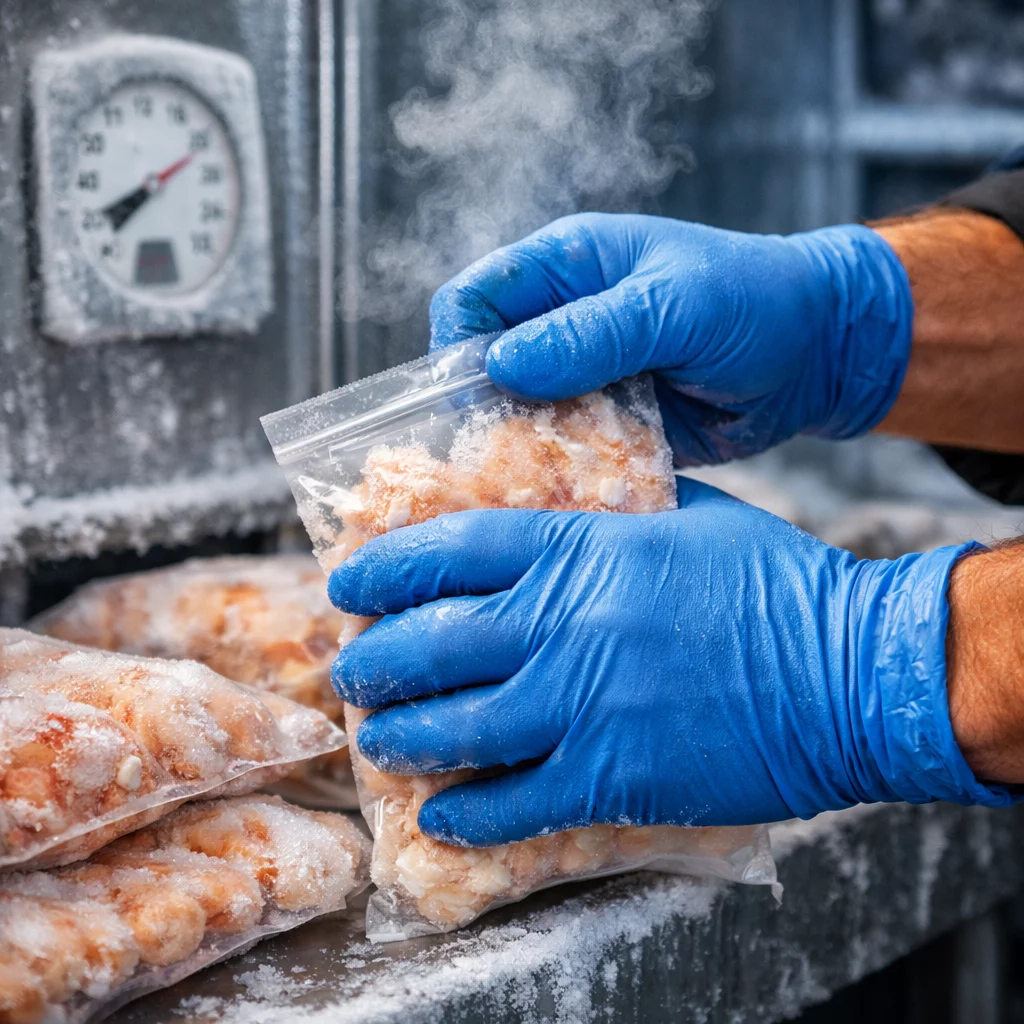
At temperatures between -15°C and -20°C, disposable gloves undergo significant material changes that affect performance and safety. Both latex and nitrile experience reduced elasticity, but the degree of degradation differs substantially between materials.
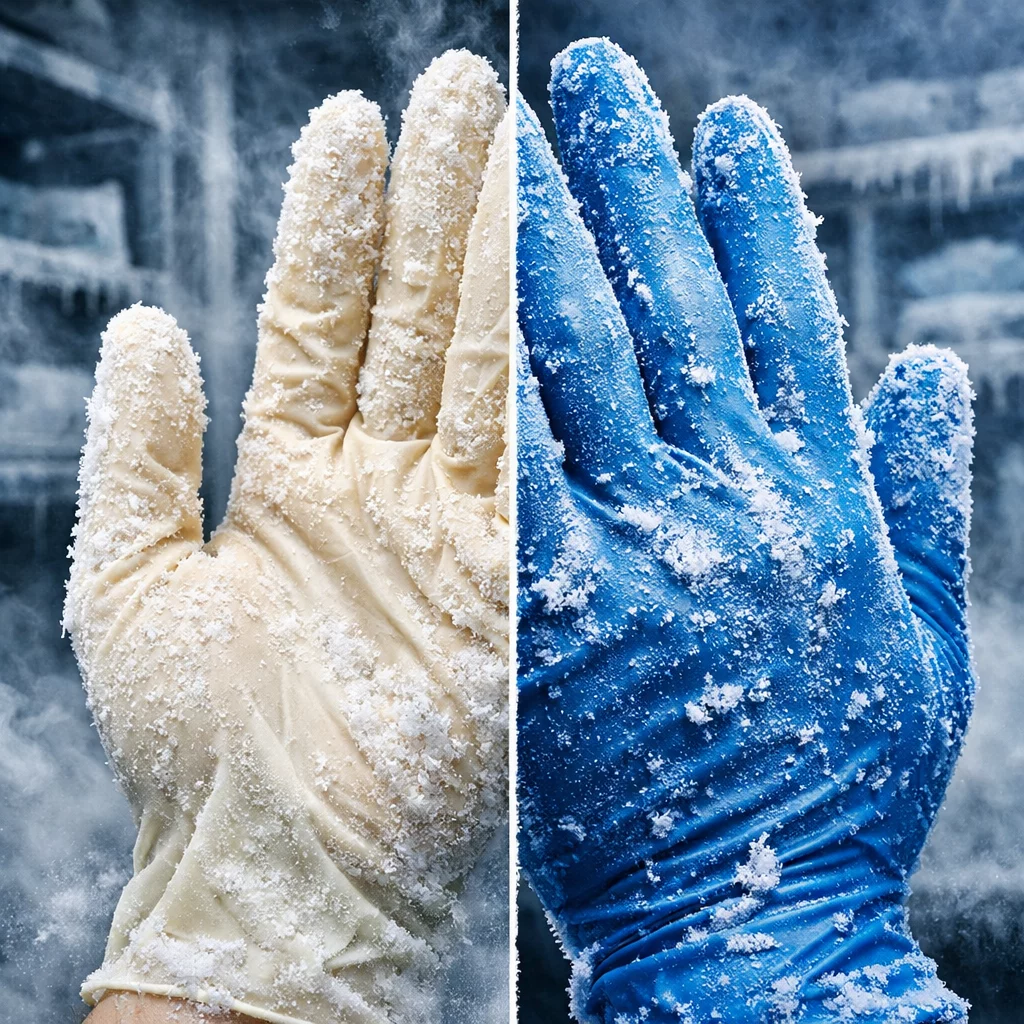
Latex gloves become rigid and lose their natural flexibility when exposed to temperatures below -10°C. The natural rubber proteins in latex contract in cold conditions, causing the material to stiffen and become prone to cracking. Workers report that latex gloves feel “cardboard-like” after just 10-15 minutes in industrial freezers, making fine motor tasks nearly impossible.
Nitrile gloves maintain better flexibility in cold environments because synthetic nitrile rubber (acrylonitrile-butadiene) has a lower glass transition temperature than natural latex. While nitrile does stiffen somewhat in extreme cold, it retains enough pliability for most food handling tasks.[1]
Material Performance Changes in Extreme Cold
Temperature effects on latex:
- Loses 60-70% of elasticity below -10°C
- Develops micro-cracks after 20-30 minutes of continuous exposure
- Becomes brittle and tears easily when stretched
- Protein structure degrades faster in freeze-thaw cycles
Temperature effects on nitrile:
- Retains 40-50% of room-temperature flexibility at -20°C
- Maintains puncture resistance better than latex in cold conditions
- Continues to act as thermal barrier, trapping body heat[1]
- Recovers flexibility faster when returning to warmer environments
Real-World Impact in Food Factories
A production supervisor at a frozen seafood facility in Norway shared this experience: “We switched from latex to nitrile three years ago for our -18°C processing line. The difference was immediate. Workers could actually feel what they were handling, and we cut glove replacements by half. The latex gloves would crack within the first hour, but nitrile lasts the full shift.”
Common cold-related glove failures:
- Splitting at fingertips when gripping frozen boxes or metal equipment
- Loss of tactile sensitivity making quality inspection difficult
- Reduced grip on frost-covered surfaces leading to dropped products
- Accelerated wear at stress points (between fingers, palm creases)
Why Nitrile Outperforms Latex in Cold Food Processing
Nitrile disposable gloves provide measurable advantages over latex in cold storage and processing environments. These benefits extend beyond simple temperature tolerance to include safety, durability, and operational efficiency.
Superior Puncture and Tear Resistance
Nitrile gloves offer approximately 3 times the puncture resistance of latex gloves at room temperature, and this advantage increases in cold conditions.[6] When handling frozen products with sharp edges, bone fragments, or rigid packaging, nitrile maintains its barrier integrity while latex develops micro-tears that compromise food safety and worker protection.
Puncture resistance comparison:
- Nitrile (5 mil): 12-15 grams force required for puncture at -15°C
- Latex (5 mil): 4-6 grams force required for puncture at -15°C
- Nitrile maintains 70-80% of room-temperature strength in cold
- Latex drops to 30-40% of room-temperature strength in cold
Chemical Resistance in Cold Cleaning Operations
Food factories operating cold storage areas must regularly sanitize surfaces with cleaning agents, often while maintaining low temperatures. Nitrile provides superior resistance to oils, fats, and many cleaning chemicals compared to latex, and this protection remains effective even at -15°C to -20°C.[5]
Chemical exposure scenarios in cold food processing:
- Sanitizing freezer surfaces with quaternary ammonium compounds
- Handling frozen products with residual processing oils
- Cleaning equipment with alcohol-based disinfectants
- Managing condensation and ice-melt water mixed with detergents
Latex gloves degrade rapidly when exposed to oils and petroleum-based substances, and cold temperatures accelerate this breakdown. Nitrile maintains its chemical barrier properties across a wider temperature range.
Allergy Safety and Workforce Protection
Latex allergies represent a significant concern in food processing facilities, affecting an estimated 8-12% of workers with repeated exposure. Reactions range from mild skin irritation to severe anaphylaxis. Nitrile gloves eliminate this risk entirely, as they contain no natural rubber proteins.[1]
Advantages of nitrile for diverse workforces:
- Zero latex protein content eliminates Type I allergic reactions
- Lower dermatitis rates compared to latex (important in cold, dry environments)
- No powder needed for donning (powder can contaminate food products)
- Suitable for workers with known latex sensitivities
In cold environments, skin is already stressed by low humidity and temperature extremes. Adding latex exposure increases the risk of contact dermatitis and compromised skin barriers.
Are Standard Disposable Gloves Rated for -15°C to -20°C?
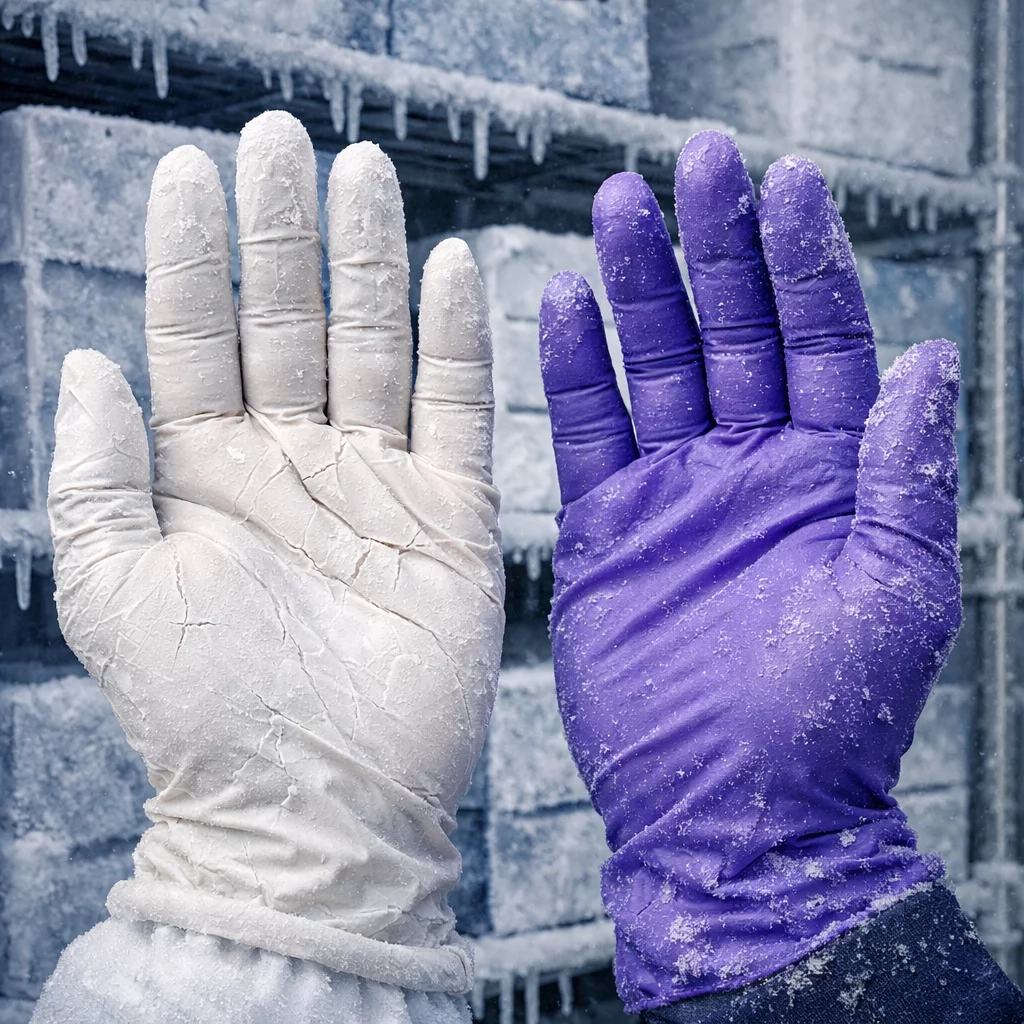
Most standard disposable gloves—whether latex or nitrile—do not carry specific temperature ratings for extreme cold exposure. This represents a critical gap in product specifications that food factory managers must understand when selecting hand protection.
The rating reality: Disposable glove manufacturers typically test and certify their products for chemical resistance, puncture resistance, and viral barrier properties, but rarely provide cold-temperature performance data. The absence of ratings does not mean the gloves fail at low temperatures, but rather that performance is not guaranteed or standardized.[1][2]
What “Insulated” Actually Means
True insulated gloves designed for cold environments feature multiple layers: an inner liner (often acrylic or terry cloth), a middle insulation layer, and an outer protective coating (which may be nitrile). These gloves are rated for specific temperature ranges and tested according to standards like EN 511 (cold protection) or ANSI/ISEA 105 (hand protection).
Examples of rated cold-protection gloves:
- Pyramex GL611: Nitrile-dipped with acrylic liner, rated to -30°C (-22°F)[3]
- North Nitri-Knit Insulated: Rated from -23°C to 149°C with foam insulation[4]
- These are NOT disposable gloves—they are reusable, washable, and significantly thicker
Standard disposable gloves (3-8 mil thickness) provide minimal insulation. Their primary function is barrier protection, not thermal protection. The thin material cannot trap enough air to provide meaningful insulation against extreme cold.
The Disposable Glove Limitation
A quality manager at a frozen vegetable processing plant explained: “We learned the hard way that ‘nitrile’ doesn’t automatically mean ‘cold-rated.’ Our workers were going through 4-5 pairs of disposable nitriles per shift in the -18°C blast freezer. We thought we were buying protection, but we were really just buying a thin barrier. The gloves worked for short tasks, but not for continuous exposure.”
When disposable gloves work in cold:
- Short-duration tasks (under 15 minutes)
- Intermittent cold exposure with warm-up periods
- Tasks requiring high dexterity where thick gloves are impractical
- Secondary protection under insulated gloves (double-gloving)
When disposable gloves fail in cold:
- Continuous shifts in -15°C to -20°C environments
- Heavy manual handling of frozen products
- Tasks requiring sustained grip strength
- Situations where glove failure creates food safety risks
How to Choose Between Nitrile and Latex for Cold Food Handling
Selecting the right glove material for cold food processing requires evaluating multiple factors beyond just temperature tolerance. The decision impacts worker safety, productivity, product quality, and operational costs.
Decision Framework for Food Factory Managers
Choose nitrile disposable gloves when:
- Workers spend more than 30 minutes per shift in -15°C to -20°C areas
- Handling frozen products with sharp edges, bones, or rigid packaging
- Workforce includes individuals with known or suspected latex allergies
- Tasks involve contact with oils, fats, or cleaning chemicals
- Glove changes must be minimized to maintain production flow
- Food safety protocols require maximum barrier protection
Choose latex disposable gloves when:
- Cold exposure is minimal (under 10 minutes at a time)
- Tasks occur in refrigerated (not frozen) environments (0°C to 5°C)
- Budget constraints are severe and nitrile cost is prohibitive
- Workers have confirmed no latex allergies in the team
- Tasks require maximum tactile sensitivity at moderate temperatures
- Gloves are changed frequently regardless of material
Consider insulated nitrile-dipped gloves when:
- Workers spend entire shifts in -15°C to -20°C environments
- Manual dexterity requirements are moderate (not precision work)
- Gloves can be sanitized and reused across shifts
- Cold-related hand injuries or complaints are occurring
- Tasks involve heavy lifting or sustained grip requirements
Practical Testing Protocol
Before committing to a glove type for your entire operation, conduct a structured trial:
Week 1-2: Baseline with current gloves
- Document glove changes per worker per shift
- Record complaints about cold, stiffness, or tears
- Track any hand injuries or product contamination incidents
- Measure task completion times for key operations
Week 3-4: Trial with alternative material
- Provide nitrile gloves if currently using latex (or vice versa)
- Maintain same documentation metrics
- Gather worker feedback on comfort, dexterity, warmth
- Compare costs including glove usage and productivity changes
Week 5: Evaluate and decide
- Calculate total cost per shift (gloves + productivity + safety incidents)
- Review worker preference (comfort affects compliance)
- Assess food safety impact (fewer glove changes = less contamination risk)
- Make decision based on data, not just glove unit cost
Cost-Benefit Analysis
A frozen pizza manufacturer in Wisconsin conducted this analysis in 2025:
| Factor | Latex (Previous) | Nitrile (New) | Impact |
|---|---|---|---|
| Glove cost per box | $8.50 | $11.20 | +32% |
| Gloves used per worker per shift | 6 pairs | 3 pairs | -50% |
| Daily glove cost (20 workers) | $51.00 | $33.60 | -34% |
| Product drops/contamination incidents per month | 12 | 4 | -67% |
| Worker cold-related complaints per month | 23 | 6 | -74% |
Result: Despite higher unit cost, nitrile reduced total hand protection costs by 34% while improving safety and worker satisfaction.
What About Insulated Nitrile Gloves for Extended Cold Exposure?
For food factory workers who spend multiple hours continuously in -15°C to -20°C environments, standard disposable gloves—whether latex or nitrile—provide insufficient protection. Insulated nitrile gloves offer a more appropriate solution, though they come with trade-offs.
Understanding Insulated Nitrile Construction
Insulated nitrile gloves combine multiple layers to provide both thermal protection and chemical/puncture resistance:
Layer 1 (Inner): Acrylic, terry cloth, or fleece liner that traps warm air and wicks moisture away from skin
Layer 2 (Middle): Foam or synthetic insulation material (in higher-end models)
Layer 3 (Outer): Nitrile coating (full-dip or palm-dip) that provides grip, puncture resistance, and liquid barrier
This construction allows gloves to maintain hand warmth while protecting against cold contact and contamination. The Pyramex GL611, for example, uses a 10-gauge acrylic liner with full nitrile dip and is rated for contact cold down to -30°C.[3] The North Nitri-Knit insulated version covers -23°C to 149°C, making it suitable for workers who move between freezer and ambient areas.[4]
Trade-offs: Protection vs. Dexterity
Advantages of insulated nitrile gloves:
- Genuine cold protection with tested temperature ratings
- Reduced glove changes (reusable across shifts)
- Better grip retention in cold conditions
- Lower long-term cost per hour of use
- Reduced cold-related hand fatigue and injury
Disadvantages of insulated nitrile gloves:
- Significantly reduced tactile sensitivity (3-5x thicker than disposables)
- Difficult to don and doff quickly
- Require cleaning/sanitizing protocols between uses
- Not suitable for precision tasks or quality inspection
- Initial cost 5-10x higher than disposable gloves
Hybrid Approaches for Food Factories
Many food processing facilities use a task-based glove strategy rather than one-size-fits-all:
Heavy handling tasks (loading/unloading freezers, moving pallets, equipment cleaning):
- Insulated nitrile-dipped gloves for primary protection
- Changed between different product types to prevent cross-contamination
- Sanitized at shift end
Precision tasks (quality inspection, product arrangement, packaging):
- Thin nitrile disposable gloves for maximum dexterity
- Changed frequently as needed
- Workers rotate out of freezer every 20-30 minutes
Double-gloving approach (for moderate-duration tasks):
- Thin nitrile disposable as inner layer (barrier protection)
- Insulated nitrile glove as outer layer (thermal protection)
- Remove outer glove when leaving cold area, keep inner glove for hygiene
A cold storage facility manager in Minnesota described their system: “We color-code by task. Blue disposable nitriles for quality checks and light handling—workers know these are for short freezer trips. Black insulated nitriles for the forklift operators and stock crew who spend hours in the cold. Yellow insulated gloves for sanitation team. It took two months to get everyone trained, but now it’s automatic.”
Common Mistakes When Using Gloves in -15°C to -20°C Environments
Even with the right glove material, improper use can compromise protection and create safety hazards. Food factory workers and managers should avoid these frequent errors:
Mistake 1: Wearing Wet or Damp Gloves in Cold
The problem: Moisture dramatically increases heat loss from hands. A damp glove in -15°C conditions can cause frostbite faster than no glove at all, as water conducts heat away from skin 25 times faster than air.
How it happens:
- Condensation forms when moving from warm to cold areas
- Sweat accumulates inside gloves during physical work
- Gloves contact ice or frost and absorb moisture
- Washing hands and not drying completely before gloving
The solution:
- Keep spare gloves accessible for immediate changes when moisture is detected
- Use moisture-wicking liner gloves under disposables for extended work
- Establish hand-drying stations at freezer entry points
- Train workers to recognize early signs of moisture (cold spots, reduced insulation)
Mistake 2: Sizing Gloves Incorrectly for Cold Work
The problem: Gloves that fit perfectly at room temperature become too tight in cold environments, restricting blood flow and accelerating heat loss. Conversely, oversized gloves reduce dexterity and create safety hazards.
Proper cold-weather sizing:
- Choose gloves one-half size larger than normal for extended cold exposure
- Ensure fingers reach glove fingertips without stretching (stretching thins material)
- Check that gloves don’t restrict wrist movement or bunch at palm
- Test grip strength while wearing gloves—should retain 70%+ of bare-hand strength
A production line supervisor noted: “We had workers complaining about cold hands even with good nitrile gloves. Turned out they were wearing size small when they needed medium. The tight fit cut off circulation. Once we resized everyone, complaints dropped by half.”
Mistake 3: Ignoring Glove Warm-Up Time
The problem: Gloves stored in cold areas start at ambient temperature. Putting on a -15°C glove immediately draws heat from hands, creating initial discomfort and reducing the effective protection time.
Better practice:
- Store gloves in temperature-controlled areas outside the freezer
- If gloves must be stored cold, warm them briefly in hands before full donning
- Pre-warm hands before entering cold areas (increases initial heat reserve)
- Rotate workers through cold zones to prevent cumulative cold exposure
Mistake 4: Reusing Disposable Gloves Beyond Safe Limits
The problem: To save costs, workers sometimes continue using damaged or degraded disposable gloves. In cold conditions, micro-tears and material fatigue occur faster than at room temperature, compromising both food safety and hand protection.
Signs a disposable glove must be changed:
- Visible tears, holes, or thin spots
- Stiffness that doesn’t recover after warming
- Discoloration or texture changes
- Loss of grip (smooth areas on textured gloves)
- Any breach of the barrier (felt moisture, chemical contact)
Recommended change frequency in -15°C to -20°C:
- Nitrile disposables: Every 2-3 hours of continuous cold exposure
- Latex disposables: Every 45-60 minutes (if used at all)
- Immediately after any suspected compromise
- Between different product types or after cleaning tasks
Mistake 5: Neglecting Hand Care Between Shifts
The problem: Cold exposure damages skin even with glove protection. Dry, cracked skin is more susceptible to cold injury, reduces glove effectiveness, and creates food safety concerns.
Hand care protocol for cold-work employees:
- Apply moisturizing lotion before and after shifts (not immediately before gloving)
- Avoid alcohol-based hand sanitizers that dry skin (use alternatives when possible)
- Check hands daily for signs of cold injury (white patches, numbness, tingling)
- Report persistent cold sensation or pain (early warning of tissue damage)
How Long Can Workers Safely Wear Disposable Gloves at -15°C to -20°C?
Safe duration for wearing disposable gloves in extreme cold depends on multiple factors: glove material, thickness, task intensity, individual cold tolerance, and whether workers can warm hands periodically.
General Time Guidelines
For standard nitrile disposable gloves (4-6 mil):
- Light tasks (inspection, light sorting): 20-30 minutes continuous
- Moderate tasks (packing, stacking): 15-20 minutes continuous
- Heavy tasks (lifting, equipment operation): 10-15 minutes continuous
For standard latex disposable gloves (4-6 mil):
- Reduce all above times by 40-50% due to faster heat loss and material stiffening
- Maximum recommended: 15 minutes for any task at -15°C to -20°C
For insulated nitrile-dipped gloves (rated for cold):
- Can be worn for full shift duration (4-8 hours) with proper breaks
- Hands should be warmed every 60-90 minutes even with insulated gloves
- Monitor individual workers for cold discomfort regardless of time
Warning Signs of Excessive Cold Exposure
Train workers to recognize and report these symptoms immediately:
Early warning signs:
- Fingers feel numb or “tingly”
- Difficulty with fine motor tasks (buttons, zippers)
- Skin appears pale or white under gloves
- Hands feel painful rather than just cold
Serious warning signs (require immediate warming):
- Complete loss of sensation in fingers
- Skin appears waxy or grayish
- Inability to make a fist or grip objects
- Burning sensation in hands
Rotation Strategies for Extended Operations
Food factories with continuous cold-storage operations should implement worker rotation to prevent cumulative cold exposure:
30-minute rotation (for disposable gloves):
- 30 minutes in -15°C to -20°C zone
- 15 minutes in ambient or warm area
- 30 minutes in -15°C to -20°C zone
- Pattern repeats through shift
60-minute rotation (for insulated gloves):
- 60 minutes in cold zone
- 10-15 minute warm-up break
- 60 minutes in cold zone
- Pattern repeats through shift
Task-based rotation:
- Alternate cold-zone tasks with ambient-temperature tasks
- Schedule precision work (requiring thin gloves) outside cold zones
- Assign cold-sensitive individuals to shorter cold exposures
A frozen food distribution center in Canada implemented a rotation system after several cold-injury incidents: “We now track cold exposure time electronically. When a worker’s badge shows 90 minutes cumulative cold time, they’re automatically rotated to ambient-temperature tasks for 30 minutes. Injuries dropped to zero, and productivity actually increased because workers weren’t fighting cold fatigue.”
What Are the Best Practices for Glove Use in Cold Food Processing?
Implementing a comprehensive glove management program ensures worker safety, maintains food safety standards, and controls costs in cold food processing environments.
Standard Operating Procedures for Cold-Zone Glove Use
Pre-shift preparation:
- Inspect hands for cuts, cracks, or skin damage (report any concerns)
- Apply approved hand moisturizer (allow 5 minutes to absorb before gloving)
- Ensure hands are completely dry before donning gloves
- Select appropriate glove type for assigned tasks
- Verify glove size and check for defects before entering cold zone
During shift:
- Change gloves immediately if damage, moisture, or contamination occurs
- Follow rotation schedule to limit continuous cold exposure
- Keep spare gloves accessible in cold zones (stored in sealed bags)
- Report any cold discomfort or reduced dexterity to supervisor
- Warm hands during scheduled breaks (not by placing on hot surfaces)
Post-shift:
- Dispose of single-use gloves properly (never reuse disposables)
- Clean and sanitize reusable insulated gloves per facility protocol
- Wash hands thoroughly with lukewarm (not hot) water
- Apply hand moisturizer to restore skin barrier
- Report any persistent numbness, pain, or skin changes
Glove Storage and Inventory Management
Optimal storage conditions:
- Temperature: 15°C to 25°C (room temperature)
- Humidity: 40-60% relative humidity
- Location: Away from direct sunlight, ozone sources, and chemicals
- Packaging: Keep gloves in original boxes until use
- Rotation: First-in, first-out to prevent aging
Inventory considerations for cold operations:
- Stock 2-3x normal glove quantities (higher usage rate in cold)
- Maintain multiple sizes at each cold-zone entry point
- Keep emergency supply of insulated gloves for equipment failures
- Track usage patterns by zone to identify problem areas
Training Requirements
All workers in cold food processing areas should receive training on:
Glove selection and use:
- How to choose appropriate glove type for each task
- Proper donning and doffing techniques
- When to change gloves (time, damage, contamination)
- How to inspect gloves for defects
Cold safety:
- Physiological effects of cold on hands
- Early warning signs of cold injury
- Importance of rotation and breaks
- How to warm hands safely
Food safety:
- Glove integrity and contamination prevention
- Cross-contamination risks with damaged gloves
- Proper glove disposal procedures
- Hand hygiene before and after glove use
Documentation and Continuous Improvement
Track these metrics monthly:
- Glove usage per worker per shift (by type)
- Cold-related hand injuries or complaints
- Glove-related food safety incidents
- Worker feedback on glove performance
- Cost per hour of hand protection
Review and adjust:
- Analyze trends quarterly to identify issues
- Test new glove products as they become available
- Update protocols based on incident investigations
- Involve workers in solution development
Frequently Asked Questions
Can I use latex gloves in a -15°C freezer for short tasks?
Yes, latex gloves can be used for brief tasks (under 10 minutes) in -15°C environments, but expect reduced flexibility and increased risk of tearing. Nitrile is a better choice even for short tasks due to superior puncture resistance and better cold performance. If latex is your only option, change gloves more frequently and avoid tasks requiring strong grip or handling sharp objects.
How thick should nitrile gloves be for cold food handling?
For disposable nitrile gloves in -15°C to -20°C environments, choose 5-8 mil thickness for the best balance of protection and dexterity. Thinner gloves (3-4 mil) provide insufficient barrier protection and tear easily in cold conditions. Thicker gloves (8+ mil) reduce tactile sensitivity but last longer for heavy handling tasks. Match thickness to task requirements rather than choosing the thinnest option.
Do nitrile gloves provide insulation against cold?
Standard nitrile disposable gloves provide minimal insulation but do retain body heat better than latex.[1] They act as a barrier that slows heat loss rather than providing active insulation. For genuine thermal protection at -15°C to -20°C, you need insulated nitrile-dipped gloves with foam or fleece liners rated for cold temperatures. Disposable nitriles work for short exposures but cannot prevent heat loss during extended cold work.
Can I wear two pairs of disposable gloves for extra warmth?
Double-gloving with two pairs of disposable gloves provides minimal additional warmth because thin materials trap very little air. A better approach is wearing a thin nitrile disposable under an insulated nitrile-dipped glove, which combines hygiene (disposable inner layer) with thermal protection (insulated outer layer). This allows you to remove the outer glove when leaving cold areas while maintaining food safety barriers.
How often should gloves be changed in cold storage work?
Change nitrile disposable gloves every 2-3 hours during continuous cold exposure at -15°C to -20°C, or immediately if damaged, contaminated, or noticeably stiffened. Latex gloves should be changed every 45-60 minutes in the same conditions. Insulated reusable gloves can be worn for full shifts but should be inspected hourly for damage and sanitized between shifts. Always change gloves when moving between different product types.
Are powder-free nitrile gloves better for cold environments?
Yes, powder-free nitrile gloves are preferable for cold food processing. Powder can contaminate food products, and in cold conditions, powder tends to clump with moisture and reduce glove performance. Powder-free gloves also reduce skin irritation, which is already stressed by cold and dry conditions. Most modern nitrile gloves are manufactured powder-free with textured surfaces for easy donning.
What’s the cost difference between latex and nitrile for cold work?
Nitrile disposable gloves typically cost 15-30% more per box than latex gloves, but total cost per shift is often lower in cold environments. Nitrile lasts longer in cold conditions, requiring fewer changes per worker per shift. When factoring in reduced product contamination, fewer cold-related injuries, and elimination of latex allergy concerns, nitrile usually provides better value despite higher unit cost.
Can cold damage nitrile gloves before they’re used?
Nitrile gloves stored at very low temperatures (below -10°C) for extended periods may experience some material degradation, but this is minimal compared to latex. Store gloves at room temperature (15-25°C) when possible to maintain optimal performance. If gloves have been stored in cold areas, allow them to warm to room temperature before use for best flexibility and durability.
Do textured nitrile gloves work better in cold than smooth ones?
Yes, textured nitrile gloves provide significantly better grip in cold environments, especially when handling frost-covered or icy surfaces. The texture creates more contact points and channels for moisture, reducing slip hazards. Choose fully textured gloves (fingertips and palm) for cold work rather than palm-only texture. The texture also helps with donning cold gloves.
What should I do if my hands hurt after wearing gloves in the cold?
Remove gloves immediately and warm hands gradually with lukewarm water (not hot) or by placing them in your armpits. Never use direct heat sources like heaters or hot water, which can cause tissue damage. If pain persists beyond 15-20 minutes of warming, or if skin appears white or waxy, seek medical attention immediately as these are signs of cold injury. Report the incident to your supervisor to review glove selection and exposure duration.
Are there biodegradable nitrile gloves suitable for cold work?
Some manufacturers now offer biodegradable nitrile gloves that break down faster in landfills, but their cold-temperature performance is similar to standard nitrile. The biodegradable additives don’t significantly affect material properties at -15°C to -20°C. Choose based on cold performance specifications first, then consider environmental factors. Verify that biodegradable options meet your facility’s food safety certifications.
Can I sanitize and reuse disposable nitrile gloves to save money?
No, disposable nitrile gloves are designed for single use and should never be washed and reused. Sanitizing processes damage the material integrity, create micro-tears that compromise barrier protection, and violate food safety standards. If cost is a concern, consider switching to properly rated reusable insulated gloves for appropriate tasks, which can be sanitized between uses according to manufacturer guidelines.
Conclusion
For food factory operations at -15°C to -20°C, nitrile disposable gloves clearly outperform latex in flexibility, puncture resistance, chemical protection, and allergy safety. While neither standard disposable glove material is specifically rated for prolonged extreme cold exposure, nitrile maintains functional performance significantly longer than latex at these temperatures.
The evidence shows that nitrile retains body heat more effectively, resists cold-induced brittleness better, and provides 3x superior puncture resistance compared to latex—critical advantages when handling frozen products with sharp edges or rigid packaging.[1][6] The elimination of latex allergy risks makes nitrile the safer choice for diverse workforces, and despite 15-30% higher unit costs, reduced replacement frequency often results in lower total costs per shift.
However, food factory managers should recognize that standard thin disposable gloves have limitations in extreme cold. For workers spending extended periods in -15°C to -20°C environments, insulated nitrile-dipped gloves rated to -30°C provide more appropriate protection.[3][4] A task-based approach—using thin nitrile disposables for precision work and short exposures, and insulated nitrile gloves for heavy handling and continuous cold work—delivers the best balance of safety, productivity, and cost-effectiveness.
Actionable Next Steps
Immediate actions (this week):
- Audit current glove inventory and usage patterns in cold zones
- Survey workers about cold discomfort and glove performance issues
- Order sample boxes of 5-6 mil textured nitrile gloves for testing
- Review incident reports for cold-related hand injuries or glove failures
Short-term improvements (this month):
- Conduct a structured glove trial comparing current latex to nitrile options
- Implement proper glove storage at room temperature near cold-zone entry points
- Train supervisors on signs of cold injury and proper rotation schedules
- Establish glove change frequency protocols based on task and duration
Long-term optimization (this quarter):
- Develop task-based glove selection matrix (disposable vs. insulated, by job function)
- Implement worker rotation system to limit cumulative cold exposure
- Calculate total cost of ownership (gloves + productivity + safety incidents)
- Create hand care program including moisturizer provision and skin health monitoring
The choice between latex and nitrile for cold food processing is clear: nitrile provides superior protection, safety, and value at -15°C to -20°C. Pair the right glove material with proper usage protocols, worker training, and rotation strategies to protect both your workforce and your products in extreme cold environments.
References
[1] Are Nitrile Gloves Insulated – https://www.armbrustusa.com/blogs/news/are-nitrile-gloves-insulated
[2] Gni N190 – https://www.mastermans.com/itemdetail/GNI-N190
[3] Gl611 Insulated Cut Resistant Dipped Gloves Nitrile Coated Ansi A6 2xl Black – https://www.globalindustrial.com/p/gl611-insulated-cut-resistant-dipped-gloves-nitrile-coated-ansi-a6-2xl-black
[4] North Nitri Knit Insulated Nitrile Gloves – https://www.alaskasafety.com/product/north-nitri-knit-insulated-nitrile-gloves/
[5] Solvstop Ni4622 – https://www.superiorglove.com/products/solvstop-ni4622/
[6] Ni Flex 5mil Latex Glove – https://liftsafety.com/products/ni-flex-5mil-latex-glove